Why an Open API is Important to the Web 2.0 Social Contract


Update: Flickr’s Stewart Butterfield has responded to this blog post down in the comments section.

“Man is born free; and everywhere he is in chains. One thinks himself the master of others, and still remains a greater slave than they. How did this change come about? I do not know. What can make it legitimate? That question I think I can answer.” Jean Jacques Rousseau.

A lot of charged language has been flying around over the past four days or so with regards to Flickr and what rights their users ought or ought not to have with regards to their content. It started off with a thread in Flickr Central when Google launched their new Picasa photo sharing app and has escalated from there to Digg, TechCrunch and now Slashdot.

As I’ve been involved in the recent debate since it started I wanted to offer up my thoughts on the matter at hand. It’s important to note that yesterday I joined Zooomr, a direct competitor to Flickr. I’ve kept quiet on the posts over the weekend because I wanted to announce that before offering up anything more on the subject than I already have.

As one of Flickr’s heaviest users I feel that I have a decent understanding of the situation and problem at present.

A number of months back Anil Dash wrote a post called “The Interesting Economy.” In this post Anil posed the most basic question of all from a Flickr user’s perspective, “what’s in it for me?”

From Anil: “But interestingness in Flickr doesn’t pay. At least not yet. Non-pro users are seeing ads around my photos, but Yahoo’s not sharing the wealth with me, even though I’ve created a draw. Flickr’s plenty open, they’re doing the right thing by any measure of the web as we saw it a year ago, or two years ago. Today, though, openness around value exchange is as important as openness around data exchange.”

Caterina Fake responded to Anil with the following: “Everyone needs to get paid, businesses need to thrive. I don’t begrudge blogs like Anil’s their AdSense links, or Flickr displaying ads on free accounts (I may have a bias there). But monetization strategy or no, the culture of generosity is the very backbone of the internet. It is why I have always loved it.”

At the time, and still today, I agree with Caterina Fake. I have always felt that I’ve gotten much more out of Flickr than money could ever provide and thus I’ve felt it more than a fair deal. I don’t need to be paid by Flickr. I enjoy the generosity that Caterina speaks of and love the share and share alike spirt of Flickr. And over the past year I’ve spent hours and hours and hours working away at my flickrstream. Uploading new photos every day, meticulously documenting my images with detailed tags, building friends and making contacts, enjoying and sharing with everyone I meet, and participating actively in many different groups and conversations on the site. But lately I’ve been having some second thoughts.

The central issue around the recent debate is not whether or not you can get your photographs out of Flickr. Slashdot got this really wrong when they wrote, “yet Flickr’s API only allows uploading, not exporting.” There are several tools that have already been developed to allow exporting out of Flickr. Downloadr and Slickr come to mind immediately.

You absolutely can get your photographs out of Flickr your photos are not locked up. Flickr is not the roach motel that others have been making it out to be.

What is at issue is not your photos, but the metadata associated with your photos. At present Flickr does not keep the tags that you use to name and organize your photos in the photo files themselves. Rather these tags are part of a larger Flickr database that Flickr associates with your images. And this is the real issue to focus on. How can you as a user, and should you as a user, be able to easily get all of your photos and the metadata associated with them out of flickr and on to a competitive platform.

Recently Zooomr requested a Commercial API from Flickr. This request, in part, was based on a desire to create an easy way for users to migrate their photos and metadata over to Zooomr should they want to try/use the Zooomr service. Zooomr was denied this request by Flickr. Other sites, like Tabblo, who is perhaps viewed as less of a direct competitor to Flickr than Zooomr have been given API keys and have in fact used them to create tools that easily allow a user the ability to transfer their photos and metadata over to their service. I personally used the tabblo service and tool to transfer all my flickr photos and metadata there and you can check out how complete a transfer it was at my tabblo page here.

I think that it was a mistake to deny Zooomr this request. I think it was a mistake because at the foundation of this great thing that we call Web 2.0 I believe there exists a social contract between companies and their users that trumps business interests. Perhaps I’m being naive here but I firmly believe that the user’s needs must always come first for any Web 2.0 company. As businesses profit from the free labor, goodwill and generosity that Caterina Fake writes of, I believe that while they may not be owed actual compensation, that they are owed every effort to protect their rights, privileges and control over that which they create and contribute.

It is very very cool how easy it was to transfer my entire flickrstream and all of the associated metadata easily and seamlessly over to tabblo. It should be that easy for any other site I choose to use as well. And while it should not be incumbent on Flickr to build the tools to do this, they should make their API available to other companies who would like to build these import tools nonetheless. They should do this because it’s the right thing to do from their side of the user generated contract.

And I think Flickr feels this way too. In fact it should be noted that after denying Zooomr’s original request, Flickr’s Stewart Butterfield has expressed that he has had a change of heart with regards to allowing competitors access to Flickr commercial API keys and will most likely grant these requests if a competitor also agrees to allow Flickr access to their open API. I applaud this effort but in fact still think it needs to go a tad further. I do think that flickr should open up their API for building import/export tools for competitors irrespective of the status of their API. Again, I may be living in a utopia here, but I do believe that in the end doing the right thing always wins out. And if other sites want to stay closed while Flickr stays open then I think in the end users will respect Flickr all the more for this and it will create a stronger bond between them and their users. Zooomr by the way is committed to an open API and Kris is working on the finishing touches on Zooomr’s as I write this.

One final thing. I think that in this entire debate Flickr has at times been portrayed as the bad guy here. This could not be further from the truth. In fact, Flickr has probably done more for user’s rights and ability to control their content then just about any Web 2.0 company that exists today. They have popularized the Creative Commons license. They have routinely listened to and actively engaged their users. They have created broad tools to allow users to offer varying degrees of access, privacy and control over their images. They have carefully cultivated an environment of mutual respect between they and their users and have constantly fought for the rights of these users. They will likely even change their position with regards to granting competitors Commercial API keys. They have been about as fine an example of good stewardship in the user generated contract as exists today. In all of this I think it’s unfair for anyone to suggest otherwise.


Why I’m Going to Work for Zooomr

Why I'm Going to Work for ZooomrWhy I’m Going to Work for ZooomrHosted on Zooomr

Zooomr, experience the world through photos.

I love photography. More than anything else this is where I find my heart, mind, thoughts and time these days. When I was 15 years old my parents bought me my first 35mm camera. It was a Sigma and it rocked my world. Since then I’ve had several cameras but the love has only intensified for me.

A little over a year ago I stumbled on the most amazing thing to ever happen to my photography. Flickr. Flickr changed digital photography for me in ways I never dreamed possible. Flickr added a whole new dimension to what photography would become for me. Flickr too rocked my world. More precisely though, Flickr did two important things for me.

First, as a photographer Flickr created an instant community of other photographers. I still remember my first Flickr meetup. cate. beautiful cate had been commenting on my photographs and invited me to a get together at the Big Foot Lodge. I was thrilled. And that night was very special for me. That night I met Sam Bloomberg Rissman and Aqui-Ali and John Curley and Sugar Booger and a whole bunch of some of the best damn people you will ever meet *and* some of the best damn people who never tire of talking with you about ISOs and apertures and RAW and JPG and prime lenses vs. zoom lenses and flickr and so on. Since that flickr meet up a little over a year ago I’ve become better friends with many of those people and I’ve made quite a few more along the way. I truly value these friendships.

Second, Flickr gave me my first real audience and interactive experience for my photography. Sure, I had a blog before Flickr and people would leave comments on my blog and say things like, “great photo,” and “wow,” but these were few and far between and I never felt like I had a connection with these people. It has been said many times that Flickr is like crack. But what makes it like crack is this interaction your work has with the people that view it, fav it, comment on it, save it, etc. For every one real life photographer friend I was making at SFlickr, I was making another 10 online friends on Flickr. Many of these people periodically made their way through San Francisco and I even got to meet them face to face. The incorrigible Mr. Chalk (yes I know he’s been deleted again), Beebo Wallace, the lovely Elinesca, helveticaneue, the list could go on.

So flickr did a lot for me. It encouraged my photography, it inspired me, it created lasting friendships. And I am today really, really into it. I started a Flickr blog. I post virtually every day on Flickr. etc. I still love Flickr and will always love Flickr. But…

About two months ago Mike Arrington wrote a blog post about a “Flickr on Steroids”. This, as you would imagine, greatly peaked my interest. After Mike’s post I took a look at Zooomr myself. And I really really liked the potential.

Since then and over the course of the past few months I’ve gotten to know Kristopher Tate, Zooomr’s founder and only employee, a bit better. Kris Tate is this ambitious 18 year old software genius.

Where Flickr has matured and emerged as the coolest photo toy on the planet, they also have had to deal with the inevitable scale issues that come with popularity. Feature improvements have slowed (as would be expected) and perhaps wisely so they must provide a great deal more thought as to how any new feature might impact a much larger audience than it might have a mere year ago.

And wile some might label Zooomr a mere flickr clone, Zooomr has nonetheless been busy building a whole host of features that Flickr does not have today. Photo trackbacks (to answer that perpetual question, “why is my photo getting 500 views?”), audio annotation, rich map integration and geotagging. And it’s only getting better from there. Wait until you see what they have in store for the future.

I’m an analytics guy. I love stats. I want to slice and dice any bit of data I can get my hands on. I want to see the 200 most popular photos on Zooomr. I want to see all photos that are not popular but have high ratings (undiscovered talent). I want to know where the traffic is coming to my photostream from, when and why. And Zooomr is building these tools too.

These things are super exciting to me — and although I’m sure that Zooomr will in time face the same kind of scale issues that Flickr does today Kris is rolling out the most amazing fun toys for the photosharing enthusiast.

Zooomr is not where it needs to be today, don’t judge the service by what’s up there now. Wait until early next month to try the 2.0 upgrade. There is a lot of work that still needs to be done. Kris needs to finish the API. A bulk uploader is just about ready. Better and better and richer and richer search. A few other finishing touches need to be in place — but they are almost there. And when early next month Zooomr launches their version 2.0 I think and hope that it will also rock your world.

This decision to join Zooomr, by the way, is in no way meant to imply that Flickr is not great. On the contrary. I spent a bit of time last night talking on the phone with Stewart Butterfield from Flickr about my decision to join Zooomr. How it represents for me personally a unique opportunity to jump into the tech startup world hands on. How working with Kris will give me an opportunity to influence many more of the great features that I feel ought to be developed from a photogeek perspective. Why I felt it an exciting opportunity and one I ought to pursue.

Personally for me though Zooomr is additive to the great photo sharing site that is flickr. I plan to continue being very active at flickr even as I grow my images and (hopefully) convince a lot of you why Zooomr is something you might want to check out as well.

Update on My Run in With Police (?) Over my Photography at 50 Beale Street

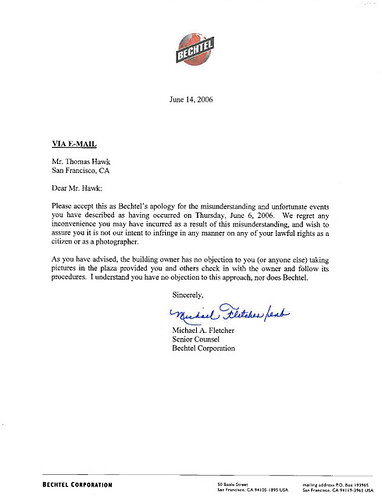
Bechtel Letter

In response to my run in with an unidentified individual who identified himself as a police officer, assaulted me and refused to show me identification as a police officer, I received this letter from Bechtel Corporation yesterday.

I have again asked for the name of the individual who identified himself as a police officer and requested Bechtel tell me what if any disciplinary action was taken against this individual.

While Bechtel still refuses to confirm whether or not the individual who harrassed and assaulted me is an employee of theirs, it is probably fair to assume that they would not be sending an apology letter were he not. I will continue to pursue this though and am confident that I will be able to get more information with regards to this case.

Update: I sent the following email to Michael Fletcher at Bechtel today: “Hi Michael, just writing to see if any update is available regarding my run in with your employee.

Also, one other thing with regards to your apology letter, you state in it that I have no objection with checking in with the building owner prior to shooting photos of the building from public space. I do actually have an objection to this and do not feel that I need to check in with the building in order to photograph it from public space. Just a clarification for the record with regards to your statement. Irrespective of this though it is none of Bechtel’s business what buildings I shot and which I do not and whether I receive permission to shoot them or not. And it is certainly not Bechtel’s role to be policing me as you yourself have already admitted.

Wired News Article on Screen Shots on Flickr

Memeorandum is tracking the reaction in the blogosphere to this articleon Flickr at Wired News talking about Flickr’s policies towards screen shots.

For what it’s worth I think screen shots ought to be allowed onflickr.I don’t think Flickr would be overun with screenshots and I think thatmany of the ones I’ve seen (and even have in my own stream) areinteresting ones and of value to the greater flickr community. I thinkallowing screenshots and other art would not be dillutive to the photosharing experience on flickr and would be a good thing for them to do. I’m not sure that I fully understand the objection on Flickr’s part.

I also posted on this at Flickr Central where you might see more commentary from Flickr or users in the Flickr Community.

Flock Rocks

Michael Arrington has a new default web browser and so now do I. Simply put, Flock Rocks. This is my first blog post directly from the Flock browser and I’ve got those same little bubbles of excitement I had when I replaced IE for Firefox.

So what is so great about Flock? Lots. First off Flickr is tightly integrated into the browser. I love that. What’s more it accepts all of my grease monkey flickr scripts giving me all of the same Flickr functionality I had with Firefox. It’s got a built in Flickr uploader (although they need to strip the .jpg file extensions from the photo titles as they upload, should be easy enough to do), it’s got a built in blog editor for blogger, it’s got a built in spell checker for both flickr and blogger, and here’s the kicker… are you ready… it’s much faster than Firefox. Hot Donkey.

The blogging tool and spellchecker just blow blogger’s default away.

Fortunately I’m on a PC because the browser doesn’t seem to support Mac yet but I suspect that this will only be a matter of time.

The installation of the browser was super easy and it easily imported all of my Firefox stuff. The layout and design are elegant and in the last 24 hours or so that I’ve played with it I have not had a single error (pretty strong for a beta). I had tried Flock a few months back and abandoned it because of the errors. This new version seems very stable.

Flock also integrates delicious and has a way to star favorite your bookmarks. I’m sure I’ll have more to write about it later.

While some advanced users might be able to hobble together an equally strong Firefox experience with extensions, add ons, scripts, etc. By default, out of the box, Flock will be a much superior browser to anyone using IE or Firefox that likes Flickr. Nice work Flock.

Update: It would appear that you can actually use Flock with a Mac.

Yahoo Scores Goooaalll In World Cup Advertising

By Davis Freeberg

I used to think that soccer was an extremely boring sport to watch. I always just thought of it as a bunch of people kicking a ball around and couldn’t appreciate the nuances of the game. Luckily, four years ago a buddy of mine dragged me out of bed at insane hours and forced me to watch the World Cup with him. At first I protested, but after a few games it didn’t take long for me to catch World Cup fever. What Soccer lacks in high scores it makes up for in suspense. Knowing that at any moment your team could win or lose creates a tension that results in huge highs and lows when when crucial plays happen.

This year’s World Cup is no different for me. So far I’ve caught ten games and I can already tell you that the next month will be a freebie for Netflix because there is just too much World Cup on and too long of a time in between tournaments.

One of the great things about the World Cup is that unlike our wimpy American sports, it doesn’t have a time out or commercial break every 10 minutes. The game pretty much runs for 45 minutes straight, then halftime and then another 45 minutes of uniterupted soccer action. Because of it’s format, Soccer has been a bit of a challenge for advertisers because it removes a lot of 30 second spot sales and with ad zapping you can especially skip the extra 30 second spots that they try and cram into the halftime show. To help counteract the loss of their precious 30 second spots, ABC has started to use banner advertising on the screen. While this might be a way that they can force viewers to watch ads, I found it pretty ineffective because my eyes were focused on the constant movement of the ball. The only time that I really noticed these ads were at the end of the games when I paid more attention to the clock.

The other major ad spot for the world cup was the signage at the stadiums. There were a lot of companies that were more then happy to pay top dollar to have their ads on the side of the field, but of these companies, Yahoo! was the clear cut winner when it came to the effectiveness of their signage. I’m sure that Yahoo! was forced to pay a premium to do this, but they negotiated to have their signs in the corner of the stadiums. This is important because one of the most crucial moments of a soccer game is a corner kick and everytime the camera focused on the player who was about to strike the ball, you could see Yahoo!’s sign in the background.

What made this advertising so effective was that not only do they get a fair amount of brand exposure throughout the game, but they got that exposure at a critical time when viewers instinctively pay more attention because the drama is heightened. Whether this was planned by evil scientists in Yahoo!’s marketing department or whether they accomplished this on accident, after watching ten games of World Cup action, I found myself immedietely getting excited everytime my eyes caught a glimpse of the Yahoo sign. Not only did I find that I noticed the signage more, but it had me drooling like Pavlov’s dog everytime the camera focused in on their big blue logo. Yahoo!’s prime placement of their ad created a way that their brand could be associated with more then the World Cup, but with the excitment that soccer fans feel when they can sense something big is happening.

By tying their ad to crucial moments in the game Yahoo! was able to make me feel that excitment in seeing their brand. With so many advertisers forcing their brand exposure on consumers, it’s hard to stand out. Whether it’s pop-up banner ads or 30 second interruptions, advertisers need to learn that there are more effective ways to tie their message to the programs that they are supporting. Whether it’s Yahoo!s consideration of what viewers feel when they see their ad or the tying of an ad to a loved character in a show, the more that brands can effectively associate themselves with the programs consumers love, the more effective they’ll find their efforts. I’m not sure how much extra Yahoo! paid for their prime real estate, but whatever the cost, by linking their brand with a tense experience they scored an early goal in the advertising World Cup.

Scoble Leaves Microsoft, Joins PodTech

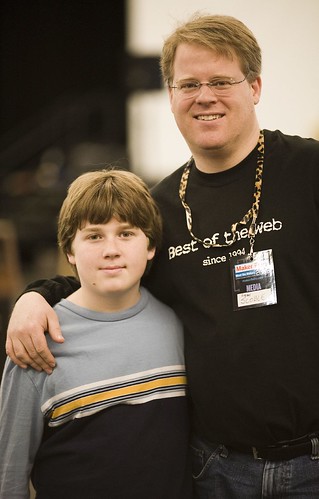
Robert and Patrick Scoble
Robert Scoble and son Patrick.

Well a hearty congratulations to Robert Scoble who announced yesterday that he is leaving Microsoft to go to work for PodTech. This is pretty big news and quite a coup for PodTech.

I first met Robert Scoble almost two years ago at a Barney’s in Noe Valley at a Geek dinner that he put on. Although I’d met him online this was the first time I’d met him face to face. Subsequently I’ve seen him many times face to face and equally online. He may be the best evangelist I’ve ever met for a company. And he really gets blogging.

The thing about Robert is that when he really genuinely likes something he can’t just help but to gush about it. I remember at that Barney’s where he brought out his tablet PC and was showing off his RSS reader in it and you could tell that this guy *really* liked his tablet PC. Oh yeah, and it was running Microsoft software. Big, bad, Microsoft embodied by this friendly loveable guy who really really loved his tablet PC. And a guy who also obviously really really loves his son (which is one of the reasons why he is moving down here to take this job). Patrick, his son, by the way was at that dinner at Barney’s. The shot above is of Robert and Patrick from the Maker’s Faire earlier this year.

But beyond my initial enthusiasm for my first meeting with Robert Scoble he continued to impress me. I had a little blog at the time (which has gotten a bit larger but is still very much a little blog), and Robert showed genuine interest in what I was blogging. I was one of the few bloggers blogging a lot about Microsoft’s Media Center Edition software, something that I really loved. Robert helped provide me significant access to people at Microsoft that I would not have had otherwise. Even though I didn’t always say good things about Microsoft or their products, I think he understood that my heart was in the right place about wanting a richer digital media experience for my living room. I’m certain that I blogged more about Microsoft than I would have otherwise because of Robert Scoble.

Scoble was an accessible person that you could go to who would help you track down information that you needed as a blogger from Microsoft. And all along the way he ran around the country having fun, meeting new people, saying great things about Microsoft, and occasionally chiding Microsoft as well, but promoting the brand everywhere he went. He took blogging seriously and was a friendly face for every blogger he met. He wrote a book along with Shel Israel about blogging.

Microsoft is losing a great evangelist with Robert’s departure. But hopefully they learned a few things while he was there. Robert worked closely with Waggener Edstrom (Microsoft’s PR agency). Hopefully they or Microsoft find some new bloggers to try and pick up where Robert left off.

The Media Center team has some great bloggers at Microsoft (Sean Alexander, Matt Goyer, Charlie Owen) and I’m sure that Scoble’s popularity made many at Microsoft consider blogging that might not have otherwise.

So Scoble says that he is going to lose his audience. “You will unsubscribe if I don’t give you a payoff. For many of you Microsoft was that payoff. Yes, Microsoft is still an interesting company for many many people in the world. When I was at my mom’s funeral, what did we end up talking about at lunch afterward? Microsoft. Everyone had an opinion about Microsoft. Everyone knew who it was. What it did.”

This is where I think he is wrong. Digital Media may be in it’s infancy but it’s where things are headed. People may not be as excited to talk about podcasting today as Microsoft, but they will be tomorrow. Digital music. Digital photographs. Digital video. PVRs. RSS. VOD. Digital media will change the way we interact with the world in so many ways in the next 10 years. This will be exciting and Robert will not have any loss of things to talk to people about and I suspect he will talk about these technologies with the same enthusiasm as he talked about that tablet PC the first time I met him face to face.

Good luck to you Robert and I’m sure you are going to do great.

More Stupidity from Your Fine Friends at Cingular

Cingular’s Big Business Mistake in 2006 First off, I’ve got a huge problem with Cingular. Even though they still are my provider today, they totally screwed me over a while back. I went through a hellacious experience, was misinformed by them several times and ended up out a lot of money over it. At least my “Cingular Sucks” article has made it to the front page of Google for the “Cingular Sucks” search. There are, by the way, about 16,900 search results for the specific quote locked “cingular sucks” search. There’s only 9,280 search results for “home depot sucks” and 21,200 search results for Walmart sucks. So I guess Cingular would be somewhere between the two in evilability, at least per some magic donkey down at Google.

But the point of this post is not for me to rant on more about how I hate Cingular. The point of the article is to link to thecingularmistake.blogspot.com where they point out the idiocy of Cingular spending $5.15 each month in postage (not to mention the printing, paper, etc. costs) to send some guy his massive bill that details every single data transfer activity on his phone.

The guy obviously does not want this huge piece of crapola cluttering up his mailbox every month so he’s blogged about the stupidity of it. “Cingular, please – a little common sense would be useful here. Those with unlimited data plans don’t really need to know each and every time they made a data transfer, because they don’t care. Does my ISP save and send me a record every time I visit a web site? Of course not.”

So hopefully Cingular decides that killing one less tree might be a good thing and takes this guys advice. But somehow I doubt that they will. In his words, “Yes, your lawyers probably gave you some reasons why you need to send out full histories of every data transfer, but they’re clearly stupid.”

Tags: