TechCrunch Gets to the Heart of the Matter on the Flickr Obama/Joker Censorship Issue

CensoredMike Arrington over at TechCrunch gave his own opinion on the recent Flickr Censorship issue regarding the removal of the Obama/Joker image and I think it’s one of the best that I’ve seen on the issue yet in a post entitled “Free Speech, Where’s the Courage“:

“Yahoo/Flickr should have asked its attorneys if the copyright claim had any validity at all before removing the image, particularly since in this case the image is so clearly non-infringing and also is so politically charged. Yes, Yahoo would have had theoretical liability by not complying if the image was later proven to be copyright infringing. But as I said above, any lawyer could tell you that this is clearly a fair use of the original Obama image, Time Magazine’s copyright and copyright around the movie.

In the past Flickr has deleted accounts of users who are critical of President Obama, but as far as I know nothing like this was done to users who were critical of Bush.

It’s clear that the Flickr team wanted to take this image down. Not only was the image removed, but the entire page was taken down with all the comments to the image. There’s nothing in the DMCA that says you have to do that, too.

Flickr lost my trust over this issue. They failed to stand up for a user who chose to display his work on Flickr over competitors. ”

I commented on Mike’s article regarding my own previous experience with a DMCA takedown notice from Flickr here.

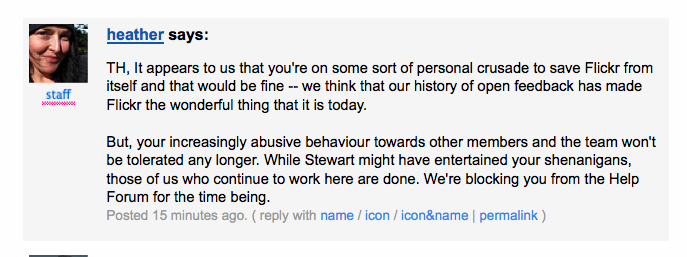
Update: Flickr responds to criticism from their users over this censorship issue by locking the thread that they are complaining in. I suppose one way to fight accusations of censorship is simply… more censorship. Oh the irony.

Flickr Censors Political Image Critical of President Obama

Flickr Censors Political Image Critical of President Obama“Flickr had removed the Joker image due to copyright-infringement concerns, Alkhateeb says the company told him in an e-mail. A Flickr spokeswoman declined to comment due to a company policy that bars discussing inquiries about individual users.”

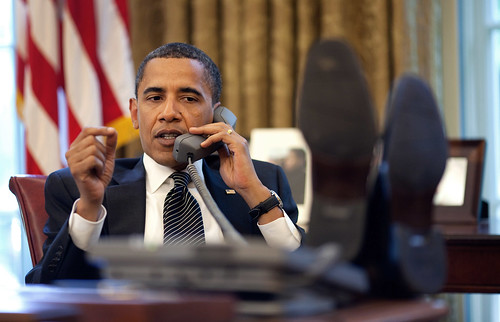
There’s an interesting piece over at the Los Angeles Times today about the unmasking of the author of the iconic Obama/Joker photo (left). The photo recently began turning up in Los Angeles with the word “socialism” printed underneath it in similar style to the famous Shepard Fairey Obama HOPE poster and since then has been the subject of considerable debate and online interest.

It turns about that, according to the Times, a 20-year-old college student from Chicago, Firas Alkhateeb, is the artist behind the work. Apparently Alkhateeb made the image using Adobe’s Photoshop software.

After creating the image Alkhateeb posted it to his Flickr account and ended up getting over 20,000 views on it. 20,000 views that is until Flickr pulled the image down censoring him, along with everyone who commented on the image, citing “copyright-infringement concerns,” according to the Times.

Personally I think it’s too bad that Flickr decided to censor this iconic image. Whatever you may or may not think about this image and it’s appropriateness, the image would absolutely and unequivocally be considered parody and parody has always been one of the most effective defenses against any copyright complaint. Parody is why Weird Al gets away with creating a song called “Eat It,” directly to the tune of Michael Jackson’s “Beat It.”

What’s more, in the interest of free speech, political parody *especially* is perhaps given the widest berth of all. This is why Ralph Nader was able to directly rip MasterCard’s “Priceless” campaign and why the courts subsequently ruled in his favor after MasterCard sued him over it. Earlier today, a friend and Flickr contact of mine from DMU, A Boy and His Prime, who is a law student, put it more directly. “If you produce something that is transformative, and not derivative, then it’s fair use (Folsom v Marsh). In Campbell v Acuff-Rose, 510 U.S. 569, Souter seemed to suggest that the main idea is substitutability, and that makes a lot of sense when you consider what copyright protects (i.e. your interest in your own work). The Jokerbama does not replace the original photo in any sense.” I’m not a lawyer myself of course and would be interested if anyone else out there who is would like to add comment as well.

Personally, I think it’s unfortunate that Flickr would embark upon yet another act of censorship when an image was so clearly parody and fair use. What bothers me even more is that this is still another example of Flickr censoring users who are critical of President Obama and his policies. In June Flickr deleted the entire account and photostream of Flickr user Shepherd Johnson after he posted comments critical of the President on the Official White House Photostream. Now I’m actually a Democrat who voted for President Obama and am super happy to see the President using Flickr. But while Flickr’s staff is obviously proud of the fact that they have President Obama’s official photostream on Flickr, I don’t think that this fact ought to be the impetuous for them to censor and delete users who are critical of the President.

I’m also troubled by this censorship in light of the clear pro-Obama bias that Flickr’s staff has shown. If you do a search for the word “Obama” on the flickr blog you get 74 different results, many of them very positive. By contrast a search for “Bush” on the Flickr blog only pulls up 5 results (even though Flickr has existed much longer under President Bush’s presidency than President Obama’s).

Now I have no trouble or problem with anyone on Flickr staff or anyone at Yahoo personally supporting whatever candidate they want. Yahoo CEO Carol Bartz personally contributed to both Bush and McCain and currently serves as a finance co-chair for Republican Gubernatorial candidate Meg Whitman’s finance committe. But I think when personal politics begin to take on a bigger role in corporate communications and especially when it begins resulting in politically motivated censorship that things have gone too far in the wrong direction. I hope that Yahoo does in fact consider it a mistake in hindsight to have deleted this clear fair use image critical of the President and that they take steps to ensure that this sort of politically motivated censorship by Flickr Staff is curtailed in the future.

I’ve contacted Alkhateeb about his image deletion and will hopefully be able to report back with more directly from him when I hear back from him.

I’ve also posted the exact same image that Flickr deleted to my own photostream. Let’s see if Flickr decides to censor me as well.

Update: bitchville over at Flickr pointed out that using the Weird Al example is actually a poor one since Weird Al actually had permission from Michael Jackson to record that song. I should have researched that more. A better example of the courts rulling in favor of parody would be that of the band 2 Live Crew and their version of “Pretty Woman.”

From publaw.com:

” The United States Supreme Court in Campbell v. Acuff-Rose Music, Inc. (1994) stated in no uncertain terms that a parody as a form of criticism or comment could be fair use of a copyrighted work. Oh, Pretty Woman is a rock ballad written by Roy Orbison and William Dees. Luther Campbell and his musical rapper group, 2 Live Crew, wrote a rap song entitled Pretty Woman that had substantial similarities to the Orbison/Dees song. 2 Live Crew attempted to obtain permission for their parody from Acuff-Rose, the publisher of Oh, Pretty Woman, but were refused permission. 2 Live Crew then proceeded without permission to release their rap song and accorded Orbison/Dees with authorial credit and listed Acuff-Rose as the publisher. Acuff-Rose then brought a lawsuit, which at the trial court level ruled in favor of 2 Live Crew based upon its fair use parody defense. This decision was reversed on appeal when the Sixth Circuit ruled against the fair use parody defense because of the commercial nature of the 2 Live Crew rendition and the presumption of market harm that the rap rendition might cause for the Orbison/Dees song. The Sixth Circuit’s decision was then appealed to the Supreme Court.

The Supreme Court accepted 2 Live Crew’s song as a parody because the rap song mimicked the original to achieve its message and because it “reasonably could be perceived as commenting on the original [Oh, Pretty Woman] or criticizing it, to some degree.””

Update 2: More from The Inquisitor, Read Write Web, and I Think.

Update 3: News Busters points out that there are plenty of anti-Bush Time Magazine covers that are on Flickr that apparently are not “copyright” violations.

Update 4: On Slashdot here.

Update 5: RWW on the NY Times here. Valleywag/Gawker on the issue here and Techmeme here.

Update 6: Flickr is now saying that they received a DMCA takedown notice over this issue. From Heather Champ at Flickr:

“Flickr must be compliant with all local laws within the 21 countries where we are. The Yahoo! Terms of Service in all of those regions outlines what the process is for dealing with infringement of copyright. In this intance, the Yahoo! Copyright Team here in the US received a complete Notice of Infringement as outlined by the DMCA (Digitial Millenium Copyright Act). Under the DMCA, an individual may choose to file a counterclaim.”

It is interesting that prior to this response by Heather that Flickr/Yahoo was stonewalling people on the issue saying that it is their policy not to discuss individual accounts. And yet now they are discussing an individual account after a barrage of negative press.

Heather also points out that “there appears to be a whole lot of makey uppey going in the news and blogosphere about this event.” [my emphasis]. It’s nice to see Flickr treat adults, blogs and news organizations reporting on a serious issue like they are children.

As Flickr has received a DMCA takedown notice, my further questions would be

1. Who filed the takedown notice?

2. Does Flickr take any steps to ensure that takedown notices are valid or do they just blindly remove them 100% of the time (note that WordPress recently defended the Fake Chuck Westall parody blog after Canon Inc., sent them a takedown request where they felt that there was no valid copyright concern).

3. Did they retain a back up copy of both the image and all of the comments that were posted to the image to ensure that they can restore them if the DMCA notice is refuted? If not, why not?

A partial list of additional coverage on this story here:

NY Times

gawker.com/5341295/flickr-deletes-obama-caricature#”>Gawker
www.prisonplanet.com/flickr-censors-obama-joker-image.html”>PrisonPlanet
FastCompany
Techmeme
Slashdot
LA Times
Newsbusters
Read Write Web
I Think
Inquisitor
Instapundit
Flickr Help Forum (I’ve been indefinitely banned from the Flickr Help Forum)
Tech Dirt
Short Form Blog
Samuel’s Blog
Disinter
Right Voices
TechTerminal
ExUrbanLeague
iPenny

In an unrelated case it seems that Flickr has received yet another public criticism in their help forum today over yet another deleted account. Apparently this account had women with bikinis on it who were tagged with the word “babe.” So in addition to shots of men without their shirts on taken by professional photographers, it seems that photos of women in bikinis now also might be forbidden on the site. No word yet if they received a DMCA takedown notice over this one yet or not of if it’s just another one of their attempts to use their vague “don’t be that guy” policy against a user.
An Update on Edelson Flores’ Account Deletion on Flickr

I've Been Banned From the Flickr Help Forum

Last week I blogged here about the case of Edelson Flores’ and his recent account deletion on Flickr. You might remember Edelson. He was the professional photographer who had his photographs posted on Flickr that all included watermarks pointing to his image copyrights. While Edelson focuses on male models, as his subject matter, his photos did not include nudity or other prohibited content by Flickr. Edelson had his account nuked by Flickr after Terrence at Flickr alleged that he was posting other people’s copyrighted work — something that Edelson denies.

Apparently Flickr may have reinstated Edelson’s account, but not without him having lost all of his photos, all of his contacts, all of his social activity on the site, and all of the time, work and energy he spent working on his profile, etc.

I received this following update earlier today from Edelson on his account Flickr deletion:

“Tom,

I believe they reinstated my account “adoniel”, but everything is gone and will need to be added and uploaded again. I haven’t even bother to try to login to that account yet, and don’t think I ever will again. Not even my profile was restored as I had hoped it would at least be the case. Considering the amount of time I spent editing my profile, photostreams, editing photos, uploading, adding titles, descriptions and tagging all the photos in my account I don’t think I will be using Flickr ever again out of fear that they may do this to me again. Ironically, I was about to buy a 2-year Pro account the same week they deleted my account. Thank God I did not spent a penny of my hard earned money with Flickr if this is how they treat their very own customers.

I did asked for a 1-year complementary Pro account as compensation and to make up for the inconvenience, aggravation and time I have wasted on this issue, but I have received no reply to that request as of yet. It doesn’t look like I will anyways. All in all it has been a really unpleasant experience and I would not recommend nor encourage anyone in their right mind to support or rely on a company like Flickr and/or Yahoo Inc. They have absolutely no respect for their own customers and deleted my account out of pure unadulterated raw unjustified incompetence. If I may also add, the communication was really slow most of the time, and at times even non existent. The only Flickr employee who showed some willingness to help and sympathy for what they did to me was Zack Sheppard. Feel free to post my message on your blog or anywhere else you would like for that matter and let the world know that Flickr and Yahoo Inc really suck.
Sincerely,

Edelson”

As a result of protesting these sort of account deletions and the fact that flickr has no viable way (nor are they even working on a way) to recover accounts when they mistakenly delete them, and especially for pointing to a new blog which seems to be focusing on an anti-gay account deletion agenda on Flickr’s part, I was called “abusive” and banned from the Flickr help forum yesterday. So much for honest and open communication.

Flickr “Not Currently Working” on Account Restore Feature After Users Suffer Losses of Thousands of Photos

Flickr "Not Currently Working" on Account Restore Feature After Users Suffer Losses of Thousands of Photos

With respect to your posting of the TV screengrab, I don’t think it was a mistake to delete it, but I do think it was (and is) a mistake to not have a mechanism to restore that kind of deletion.
— Stewart Butterfield, Flickr Founder and Former Flickr Chief, May 19, 2007

"I’m afraid this isn’t the result of some work we’re doing on a restore feature… I’m sorry to disappoint that it’s not the result of a feature. We have heard your feedback about that here, and in the past, and we know it is on some people’s wish list, but it’s not something that we are working on currently."
— Zack Shephard, Flickr Staffer, August 7, 2009

Over two years ago Flickr Founder and former Chief Stewart Butterfield publicly posted that it was a "mistake" for Flickr not to have a mechanism to restore photos that had been deleted on Flickr. He made the comment in response to a photograph of mine that Flickr had censored that he said was not a mistake, adding though that not having a restore photo capability more broadly was in fact a "mistake" at Flickr.

Last week there were several stories having to do with account deletions at Flickr. In one case a hacker had gotten a hold of a Flickr users credentials and deleted over 3,000 photos in a user’s photostream. Another case involved a professional photographer who had his entire stream nuked after being informed by Flickr that the reason for this was that he was posting other people’s photos (something the photographer, who had all of his images watermarked with his own copyright info, denies). Yet another case involved a Flickr user who apparently had some of his Flickr photos posted in an internet forum without containing links back to Flickr. In this last case Flickr agreed that it looked like "maybe the deletion wasn’t the right course of action," adding that the user was "lucky" that they were able to catch the account deletion due to a backlog of account deletion processings and then restoring his account and giving him four free years of Pro account status.

There have been other even higher profile cases of Flickr account deletion as well. Earlier this year, Flickr nuked user Shephard Johnson’s entire photostream and account after he posted comments critical of President Obama on the official White House photostream. In that case Johnson lost about 1,200 photos of his, many of them which were not backed up. Johnson was offered a free Flickr Pro account after the fiasco but like previous users was told that Flickr could not restore his account.

As it stands now when a user’s photostream is deleted at Flickr it is gone. Erased. Permanently and irrevocably. Many Flickr users are appreciably nervous about this fact, especially after reading stories about hackers infiltrating flickr accounts or when overzealous underlings in the Flickr Censorship Division seem to overreact to minor Flickr Community Guidelines violations by nuking users’ photostreams.

When Flickr nukes a user’s photostream, it’s not just the users’ photos that are gone. It’s all of the rich, important and vibrant social metadata around the photos that are gone with it. I’ve had many very long engaging conversations around my and others photos on the site. When Flickr nukes your stream those all get erased from existence.

Flickr user Saint Seminole summed up the problem fairly succiently:

"So personally, I wouldn’t be worried about losing the photos themselves. I’d be worried about losing all the work I’d put in the site over the past few years. All those cross-photo links, all the links from my blogs and others back to my flickr photos, all the website links I have directing people to my Flickr sets, my collections, my tag groupings, my archive date links, and on and on.

All the meticulous placing of photos on the Flickr map, in hundreds of cities and several countries…

This is why I personally would be worried about an accidental deletion, not the losing of photo files. This certainly seems like it should be a *MUCH* higher priority than redesigning "post now" buttons, etc. For Flickr, this should be a number one priority to protect its reputation…"

The answer to all of these concerns is rather simple really. Rather than permanently deleting accounts when Flickr feels that a user has crossed them, they could instead simply convert the account to a private account on Flickr making the stream invisible to everyone in the Flickrverse except the individual user. By locking the account down this way Flickr would be able to remove whatever it is that they find offensive while still allowing the user the ability to download photos of theirs that are not backed up or allowing Flickr to restore accounts where their censors make mistakes or overreact to minor guidelines.

Many Flickr users put tens, hundreds, in some cases even thousands of hours into building their flickr photostreams. More than just their time and energy though, what so many are offering up through Flickr is their art. Something that carries a far greater emotional cost than simply time or money. And all of these people have to live with the knowledge that their entire creative endeavors on Flickr could be blotted away with the 2 second push of a button. So it was very disappointing yesterday reading more than two years after Flickr Chief Stewart Butterfield called the inability to restore photos on Flickr a "mistake," that Flickr still today is not working on a mechanism to restore deleted photos. What bothers me as much if not more than the fact that Flickr won’t develop this important feature is that they refuse to even provide their reasoning for why they will not.

I have a hard time believing that the reasons why Flickr will not offer this sort of safety net have anything to do with engineering resources. Recently Flickr changed all the delete buttons on the site red. They also went to the trouble to personally code the "about Flickr" staff page so that it shows me, Thomas Hawk a single user, a different staff than it shows every other user. How is it that Flickr seems to have the staff resources to do these relatively insignificant coding projects, and yet they don’t have the resources to code a sane and reasonable restore feature for bad account deletions?

I’m not quite sure what the answer is to getting Flickr to agree to this important safety net. They basically have a monopoly on the community photo sharing space at present and can pretty much get away with doing anything that they feel like with impunity no matter how much it upsets their users. And that’s too bad.

Update: After refusing to address the issue of why Flickr won’t commit to a reasonable, responsible and sane approach to account deletion recovery, as is typical, Flickr staff has returned with a non-answer and locked the thread to avoid future criticism against them.

From Flickr Staffer Zack Shephard: “Since the OPs issue has been resolved I’m going to close this down. We have left it open because there was obviously some concern about this and we wanted to let discussion keep going. There is a lot of food for thought here and thank you all for letting us know about your concerns. This is still the help forum though and because the OPs issue is resolved I think it’s time to move on to the next.” And just like that another conversation critical of Flickr is killed.

Flickr = Censorship (Updated)

flickr = censorship

An update on Edelson Flores’ account deletion case here.

Well unfortunately another week is upon us and that means we have to deal with yet another case of Flickr/Yahoo censorship. The victim this time is professional photographer Edelson C. Flores. Flores first aired his concern about his account deletion in the Flickr Help Forum after trying to contact Flickr staff privately with no success. That thread subsequently was locked by Flickr staff. Flores tried to again air his concern in another thread in the help forum that also was promptly locked as well.

From Flores’ original complaint:

“I have written several times asking why my account “adoniel” was deleted several days ago without any previous notice or warning but I have yet to receive a formal reply from Flickr with an explanation. I am a professional photographer and all the content in my photostream was my own work, creation and intellectual property. I also don’t believe I had posted any content that would have been deemed inappropriate or violated your guidelines. I am very disappointed as I had spent a great deal of time uploading my photos, tagging and adding descriptions. Your actions are extremely inconsiderate and highly questionable. I was about to upgrade my account to a Pro 2-year account, but I am very glad I did not upgraded. I would prefer to spend my money elsewhere if this is how you treat your customers. You have certainly lost my trust, business and support. I am writing to Yahoo Inc, your parent company to let them know exactly how you run this web site and treat customers. I am very disappointed with your actions and lack of communication.
Sincerely,

Edelson C. Flores
Flickr: “adoniel” “

In addition to locking the threads above where Flores was protesting his account deletion, Flickr also redacted the name of the Flickr staffer in question who had provided Flores the reasoning for his account deletion, Terrence.

Below is the original email informing Flores of his account deletion provided by Edelson to me:

[Flickr Case 1278697] Re: Report Abuse: Other Concerns
Thursday, August 6, 2009 4:06 PM
From:
This sender is DomainKeys verified
“Flickr Support”
Add sender to Contacts
To:
adoniel@yahoo.com
Hello,

Flickr account “adoniel” was deleted by Flickr staff for
violating our Terms of Service and Community Guidelines.

http://www.flickr.com/guidelines.gne

# Do upload content that you have created.
Respect the copyright of others. This means don’t steal
photos or videos that other people have shared and pass
them
off as your own. (That’s what favorites are for.)

# Don’t upload anything that isn’t yours.
This includes other people’s photographs and/or stuff that
you’ve collected from around the Internet. Accounts that
consist primarily of such collections may be terminated.

Flickr reserves the right to deactivate your account
without warning at any time.

-Terrence

Based on the above email it would seem that Flores’ account was terminated because Flickr alleged that he was hosting photographs that were not his. But Flores tells a different story. When I contacted Flores about this issue he said, “I have been a professional freelance photographer for the last 10 years. All the content/images that were posted in my Flickr photostream were all my work, creation and intellectual property.” Furthermore all photos in Flores’ stream were watermarked with his own personal copyright information. It is hard for me to see how Flickr could make a mistake of deciding that these photos did not belong to Flores.

When I asked Flores if he’d received further emails or warning emails from Flickr regarding his account, he said he had not. He said that the email above was the only email that he’d received from Flickr.

I’ve contacted Yahoo to try and get their side of the story on this although I have not heard back from them yet. I suspect, as is the case in other situations that they will refuse to comment on Flores’ case and refuse to reinstate his account. This is not right.

Flickr owes their customers better than this. When we spend our time and energy investing in the work to upload, tag, store, etc. our photos on Flickr, Yahoo owes us at a minimum a warning before they delete accounts, as well as an appeals process to reinstate deleted accounts. Flickr’s policy of shoot first, ask questions later is short-sighted. Because Flickr largely has a monopoly on the online photographic community, however, they seem to feel that they can abuse their customers and get by with impunity. And that also is too bad.

Personally I think that Flickr owes Flores an apology and also owes him his account back. Rather than trying to push yet another of their censorship mistakes under the rug by locking threads complaining about it, they ought to own up to their error and offer us a roadmap on how they will prevent this sort of error from happening again next week. Unfortunately though it seems that to Flickr/Yahoo, it’s just one more disgruntled censored customer and who the hell cares about that.

Update: It seems after yesterday’s account deletion without warning, Flickr is back at it again today. Read the latest complaint below taken from the Flickr Help Forum by user Riann Flynn:

“Hey there!

I think my account was deleted and i’m not sure why! I had hundreds of thousands of views, i was on the front page of explore a few times and I was an active member of many groups! My account just disappeared

I’m ok just starting over, but can i have my old url back? This way i dont have to redo all the links in my website and what not.

Please get back to me quickly. I have tried emailing CS, but i haven’t gotten a response!

Thanks!
Rian Flynn
http://www.RianFlynn.com

flickr.com/photos/rianflynn”

More here.

KGO, KNTV, KABC, KTTV, KTLA = Censorship

Those of you who know me know that I hate censorship in most forms that it takes. I think that free speech is an important part of a free society. While Government censorship is perhaps the worst kind (and certainly folks living in places like China have it a lot worse than we do) I really hate all censorship. The worst censors though, I think, are the ones that employ censorship to censor political speech. So I was especially disappointed to read yesterday about several Bay Area and Los Angeles based TV news outlets refusing to sell air time for a 30 second commercial about the marijuana legalization debate. While I personally support the legalization of marijuana and the tax revenues that such an initiative might bring, I don’t think that is really the issue here. I’d be just as offended if these same media outlets refused to sell advertisement time to opponents of the legalization of marijuana.

Although the media are private companies and are not legally required to remain uncensored, I think it’s very bad form when they actively engage in censorship, especially censorship of this type. I think that when a media outlet is granted the privilege in our society of controlling a large chunk of public attention that they owe it to us all to remain politically neutral when it comes to paid advertisements. The ad that was rejected can be seen above. I’d encourage you to check it out, fave it on YouTube and share it with other people on your blog, on places like Twitter and Friendfeed and in other public forums. The ad is not offensive. It’s an honest attempt by a political organization to present an opinion that now is the time for California to consider legalizing marijuana.

Despite this honest attempt at public discourse though, the media outlets named in the headline of this post, KGO and KNTV in the Bay Area and KABC, KTLA and KTTV (Fox) in Los Angeles have refused the ad above. Interestingly enough several other media outlets including CNN, CNBC, MSNBC, KPIX, KXTV, and KRON are currently running the ad.

Anthony Citrano has also written an insightful post over at The Huffington Post where he give more details about this unfortunate act of media censorship.

eBay’s Hypocritical Censorship

PayPal, eBay and SkypeA number of years back I used to collect Mobile Fidelity Sound Labs CDs. I’m not sure why, but they seemed to be valuable on eBay and so whenever I’d go shopping at Amoeba or someplace and I saw one for sale for cheap in the used CD bin I’d just buy it knowing that it was collectible and worth more money than they were selling it for. I got tired of collecting them after a while and so they sat in the attic for years. Recently my wife and I decided to clean house a bit, get rid of the clutter and start selling off crap that we just don’t need any more and so she’s been putting these old CDs up on eBay and selling them off. They usually go for anywhere from $20 or so to $150 per disc.

Earlier this week she tried to list one of the CDs, Blind Faith’s self titled CD. It’s a pretty famous album but on the cover there’s a photo of a young girl holding a silver space ship without a top on. I certainly wouldn’t consider it child porn. You can see the album cover if you want simply doing a Google Image Search for “Blind Faith” “self titled.”

After listing the CD along with an image of it eBay pulled the listing. She figured it was because of the album cover and so she relisted it, only this time without a photo of the cover and eBay pulled the listing again sending her the following email explanation:

To protect our users, recognizing that images of nude children often raise legal concerns, eBay has made a policy decision that it will not permit the listing of any item that depicts images of nude minors (under 18 years of age).

Now it feels kind of crappy to have eBay calling you a child pornographer. Especially when listing a mainstream rock CD that I’m pretty sure any court in America would rule is not child porn. I think eBay is also entirely hypocritical in their rejection of this item. eBay says that they “will not permit the listing of any item that depicts images of nude minors (under 18 years of age),” and yet if you do a search on eBay for Nirvana’s most famous CD “Nevermind,” you’ll find tons of listings. Isn’t that a naked baby on the album cover? Isn’t that naked baby nude and under the age of 18? What about nativity collectible with a naked baby Jesus in the manger? Isn’t that also depiction of a minor under the age of 18 naked?

eBay needs to learn to relax their censorship here. Not allowing someone to sell Blind Faith’s classic self titled album is just stupid. What’s next? Is eBay going to stop allowing breast pumps to be sold because someone might take a photo of a mother using one that ends up on Facebook?

Flickr User Posts Comments Critical of Obama on the Official White House Photostream and Has His Comments Along With His Entire Flickrstream Deleted Without Warning

P060809PS-0350

If you don’t think that Flickr should delete accounts without warning and censor political speech digg this here.

I was dismayed today to read about the latest alleged case of Flickr Censorship. Censorship (or as they like to call it “moderation”) continues to be a problem on Flickr.

The most recent case is that of Flickr User Shepherd Johnson. According to Johnson on the evening of Wednesday June 3rd, he posted comments critical of President Obama on “8 or so” photos on the White House’s official Flickrstream. He said that he posted these comments because he was upset with the language that Obama chose to use in his recent Cairo speech regarding terrorism. Johnson said that two days later his comments had been scrubbed and deleted from the Flickr photos. Johnson shared with me the type of comment that he made and what he shared with me seemed appropriate and polite.

On Friday, June 5th, once again Johnson posted more comments on photos in the official White House Flickrstream. This time comments that were critical of the President’s recent decision to try and withhold photographs of detainee prison abuse.

From Johnson:

“Well, Friday it so happens is the day the Senate voted and passed the Graham/Lieberman bill called The Detainee Photographic Records Protection Act of 2009. Which allows the Obama administration to withhold from the public photos of horrible acts used by the Bush administration in it’s so called War on Terror. This to me was unacceptable. There are so few venues where the public can air grievances with our leaders and our government. This forum being the Official Whitehouse Photostream is an acceptable (I thought) place for me to make my comments known.”

Unfortunately for Johnson at about 11:00pm on June 05, 2009 when he tried to log on to his flickr account, he found that it was terminated without warning.

Again from Johnson:

“No explanation or anything. One second I was on and then I could not access my account. When I got back onto flickr using another account I went back to the Whitehouse site and all of my postings had been scrubbed. They were gone. I had about a years worth of work on that account and they just terminated my account with no warning. Some of the photos I had on the account had no back ups so they are now gone forever.”

You can see a cache of Johnson’s deleted Flickr account here. It was a paid Pro Flickr account with over 1,000 photographs in it.

It is interesting that Johnson was also using his Flickrstream to post additional photos that he had taken of government officials. Here is a flickr photo of his of his still intact from wikimedia of Fed Chairman Ben Bernanke leaving Bilderberg last year. In fact, if you look through the cached copy of his former Flickrstream you will see that a great deal of the photographs in his flickrstream were of political events, protests and politicians.

It is very unfortunate that Flickr would choose to take this course of action with one of their members. Freedom of Speech is an important thing and something that ought to be encouraged at Yahoo, not punished. Political speech especially ought to be give a very wide berth with regards to tolerance. It is even more eggregious given that this user was never even warned over the comments that he made, his account was simply irreversibly and permanently deleted. It is wrong for Flickr to do this. I’ve long argued that at a minimum Flickr ought to suspend offensive accounts temporarily (they could easily do this by simply making every photo in a user’s stream private) and allow an appeals process for grievances rather than simply acting with dictatorial power as a censor.

I contacted Yahoo regarding this latest censorship on their part and received back the following official response from their PR firm:

Flickr Statement:

In accordance with Flickr’s policy, we cannot disclose information to third parties concerning a member’s account. However, in joining Flickr, all of our members agree to abide by our Community Guidelines. These guidelines require that all of our members be respectful of the community and flag content that may not be suitable for “safe” viewing. Our members have always done a great job of identifying inappropriate and offensive content on Flickr and bringing it to our attention. We encourage all members to continue to make Flickr a safe place to share photos and videos.

Flickr is a very large community made up of many types of members from all over the world, and we respect the viewpoints and expressions of all of our members. In crafting the Community Guidelines, Flickr weighed the rights of the individual vs. the rights of the overall community, and built a system that would enable members to choose what they want to view. As with any community, online or off, there are members who may disregard the Community Guidelines. When this happens, Flickr may have to take action accordingly towards building a respectful community. For more information: http://www.flickr.com/guidelines.gne”

Update: In another forum here, Johnson has stated that he left a voicemail on Carol Bartz’s personal cell phone on the matter. He said after leaving this message that he had a returned phone call from Flickr Community Manager Heather Champ who told him that this account was deleted because he posted a photo of a prison detainee and because they accused him of “spamming” flickr. You can read the relevant forum thread here. Apparently another flickrstream where Johnson got the detainee photo was also deleted. Johnson is also stating that Heather told him that she did not know anything about the other deleted comments which may mean that they were actually deleted by the White House itself.

From Johnson: “She said that [edit: posting a detainee abuse photo] was part of the reason and the other part was that she claimed that I was spamming the forum, to which I asked her if she also gave warnings to the people who posted on twenty photographs the same “That’s my President Go bama!” type drivel over and over and over again. I also had her define the word “spam”, to which she could not. She seemed very careful to place her words correctly. We talked for about two hours. I think Carol really got under her skin. Carol apparently didn’t speak with her directly, she got the trickle down effect. Oh yeah, she offered me a $24.99 gift card for a new pro account but told me my precious photos and the hard work that I put in over the past year were irretrievable. I had over 53,000 views on that account. Some consolation.”

Update #2: More from Johnson: “Heather only mentioned that she deleted the comments concerning the Abu Ghraib photo, when I asked her about the original comment on the Obama Cairo Speech she had no idea what I was talking about. I crafted my dialogue with her to find out exactly what she knew and when she knew it. That means that somebody connected with the Whitehouse, one of Peter Souza’s staff or an intern, deleted my comments originally.

Update #3: See more on this story from the San Francisco Chronicle here and Gawker here, and the Silicon Valley Insider here, and Techmeme here, CNN here, BusinessWeek here, and the NY Post here, if you prefer Italian here.

Microsoft Doesn’t Think People In India Should Be Allowed to Search for the Term “Sex”

Microsoft Doesn't Think People In India Should Be Allowed to Search for the Term "Sex"

Thanks to sandelion for pointing out an interesting fact to me about Microsoft’s new search engine bing. I blogged about bing earlier this week and have been using it as my default search engine instead of Google all week. Apparently Microsoft has decided that part of their job with the new search engine is to become the world’s new censor.

At first I couldn’t believe this. Why would Microsoft think limiting the information provided in a search engine to be a good thing? But then I tried it myself. You can try it too. Just change your location preference in bing from the U.S. to India and try searching for the term “sex.” Yes, Microsoft has decided in their infinite wisdom that Indians should not be allowed to search for information about sex. In Microsoft’s words, “The search sex may return sexually explicit content. To get results, change your search terms.” That’s right, there’s no, “okay, I’m a big boy, go ahead and show me my results” button next to this Microsoft error message, there is simply a message telling you to change your search term. It’s like an instant trip back to the Victorian age.

Now in fairness, it seems that people in India could always just change their country preference from India to the U.S. to get these search results, but it’s still super lame that Microsoft would deem it necessary for people to have to change their country preferences to look up something as universal as “sex.” And many people of course won’t think to do this.

Google, by the way, has no problem with people searching for the term “sex” in India. I guess that’s all part of that whole “organizing the world’s information and making it universally accessible and useful” thing that they seem to be after. Since bing supposedly stands for “bing is not google,” maybe Microsoft should adopt their own mission statement for bing. It could be “censoring the world’s information and making it inaccessible and useless.”

This sort of censorship is a really stupid decision on Microsoft’s part. It’s the biggest reason yet I’ve heard for why I won’t use bing anymore. Censorship sucks Microsoft, don’t you know that yet?

More here.

On Slashdot here.

Should Photographers Be Allowed to Photograph the Flag Draped Caskets of Killed US Soldiers?

Clifford“I think it’s very dangerous for a free society to have all the information distilled and packaged by our government and given to us. Do we know to this day who we killed in Iraq? I don’t think so. If bringing war into the living room means that we as a people will say we don’t want to do it that way anymore we want to figure out other ways to solve these conflicts, then I would say that photography and television have done us a great service.”

– Michael Deaver, former Deputy White House Chief of Staff

An interesting article in the NY Times yesterday about photographing the coffins of fallen U.S. soldiers. According to the NYT, Defense Secretary Robert Gates has ordered a review of a military policy which prohibits the media from photographing the coffins of U.S. servicemen and servicewomen.

From the NYT:

“He said he was ordering a review of the military policy that bars photographers from taking pictures of the return of the coffins, most of which are coming from Iraq and Afghanistan and go through Dover Air Force Base in Delaware. He also set a “short deadline” for a decision. The military has said the policy is meant to protect the privacy of the families of the dead soldiers and maintain dignity. But skeptics, who include some families as well as opponents of the war in Iraq, say that the bodies in the returning coffins are not publicly identified, so privacy is not an issue, and that barring photographers is a political maneuver meant to sanitize the war.

The policy was put into place in 1991 during the first Gulf war and was renewed by the Bush administration as recently as a year ago when, Mr. Gates said, he raised the possibility of changing it. He said he was told — he did not say by whom — that allowing photographers would put undue pressure on families to go to Dover themselves and that in some cases that would be a hardship.”

My own personal opinion on this one is that you have to put the privacy of the families of these soldiers up against the broader rights to a free press and free speech. Given that there is no identifying information being photographed on these flagged draped caskets, I’d probably lean towards having this rule by the military overturned.

One thing that has been troubling to me about the war in Iraq is how restricted a free press has been. The quote above comes from former Deputy White House Chief of Staff Michael Deaver. Deaver said that in the documentary “American Photography, A Century of Images.” In that documentary Deaver talked a lot about how restrictive photography has become for war reporters.

Many cite the gut wrenching imagery coming from the Vietnam war as being a large part of what eventually ended that war. Even more than video, still images can evoke a power that is unmatched. A naked napalmed girl running down a road. A Buddhist monk lighting himself on fire, Eddie Adam’s famous image of an execution of a Viet Cong. These images leave an indelible imprint on our emotions and thinking.

Having learned how the opposition to the Vietnam War used these images, the current U.S. Military has been far more restrictive with photography in Iraq and Afghanistan. In addition to prohibiting photographs of things like caskets, the U.S. Military has been even more restrictive on the battle field.

In an article by Michael Kamber and Tim Arango in the NYT, they dig deeper into the pro-censorship policies of the U.S. government asking the question why are there 4,000 U.S. deaths and only a handful of images. In that article they report on the story of Zoriah Miller, a war photographer who took images of marines killed in a suicide attack and then faced tremendous professional repercussions from Maj. Gen. John Kelly who worked to have Miller barred from all U.S. military facilities throughout the world.

From the NYT:

” “It is absolutely censorship,” Mr. Miller said. “I took pictures of something they didn’t like, and they removed me. Deciding what I can and cannot document, I don’t see a clearer definition of censorship.”

The Marine Corps denied it was trying to place limits on the news media and said Mr. Miller broke embed regulations. Security is the issue, officials said.”

Seeing coffin draped caskets may make us all feel uncomfortable. But sometimes that’s what good photography is supposed to do. It’s supposed to make you feel uncomfortable. What do you think? Should the U.S. Military begin allowing photographers the ability to photograph flagged draped caskets of U.S. soldiers?