Final Fantasy Turns Into Final Nightmare For Xbox 360
By Davis Freeberg
Over the course of my life, I’ve been lucky enough to live through the evolution of the video game industry. I’ve gone from the rudimentary graphics of the Commodore 64 to the powerful functionality of the Xbox 360 and it’s been a pretty amazing journey. During this time, I’ve gone through several console upgrades and have always gladly spent my money in order to get access to the latest technology. Almost every upgrade has been exponentially better then the previous console and as a consumer I’ve benefited tremendously from video games moving from the fringe to the mainstream with just one exception. The only “upgrade” that I ever regretted was when I sold my PS2 in order to buy the first Xbox. At the time, Microsoft was behind in the console war and they committed a lot of capital to promoting their new box. I’m not sure how it happened, but somehow I managed to get sucked into the hype and gave up my new PS2 in order to be right on the cutting edge of video game technology.
At first I was actually pretty happy with my exchange. At the time, the graphics were very impressive and having access to Xbox live really changed the dynamics of how you play video games. It wasn’t until I went to buy my two favorite games that I learned the Xbox fatal flaw. The best games were locked up in exclusivity agreements with Sony. Somehow Microsoft had failed to secure the licensing rights to the Grand Theft Auto and the Final Fantasy franchises.
This was pretty upsetting to me because GTA 2 and Final Fantasy IX were two of my favorite games. I figured that Microsoft would end up at least releasing a couple of decent knockoffs, but the only good role-playing game for the Xbox ended up being Fable and even that fell far short of my expectations for an RPG.
Because of their problems securing games, I decided that the second time around, I wouldn’t fall for the hype and would wait for the PS3 to come out before my next upgrade cycle. I was pretty convinced that I’d be waiting one more year before my next upgrade until I saw that Microsoft had somehow convinced Squaresoft to cross license the game on their platform. As soon as I heard this news everything changed for me and Microsoft’s support of the Final Fantasy franchise ended up being the critical reason behind my choosing the Xbox 360 over the PS3.
When the Xbox 360 came out I was so eager to upgrade that I paid a scalper on Ebay just so that I could have the console before Christmas. I also started tracking the release date for Final Fantasy XI and waited eagerly for the game to come out. Unfortunately, there were a few delays with the game and every time I saw the release date pushed further out, it became increasingly frustrating after having waited so long. Finally, Microsoft settled on the release date of April 18th for the game and I quickly pre-ordered my copy from Amazon.com.
The closer it got to the 18th, the more excited I became about the game and when Amazon erroneously sent me an email telling me it had shipped a week early, I got really excited. When the game didn’t arrived I contacted Amazon and they told me that not only did the game not ship early, but that I’d have to wait until April 21st before their vendor would ship it and then 5 more days for it to arrive in the mail. Having already waited five years for the game, I couldn’t wait any longer and cancelled my order in lieu of buying it in a retail store on the day of the release.
On the 18th, I called Best Buy to see if they got their shipment of the game and they told me that the game had been delayed yet again for two weeks and that I needed to check back in May for the game. This didn’t seem right to me because the Xbox website still showed April 18th as the release date, so I immediately went into panic mode and started calling, EB games, Circuit City, Toy’s R Us, Wherehouse Music, Sears & Gamestop for the game. Each retailer gave me different information about the release information for the game and it wasn’t until I called Gamestop that they told me that the 18th wasn’t really the release date for the game, but rather the shipment date that Microsoft sends the game to retailers. This seemed a little deceptive to me because there was no way that consumers could actually play the game on the 18th. You would never say that the release date for a hot movie was the 18th and then have no theaters show the film, but apparently it’s Ok to say that a release date is the 18th, even though consumers can’t even buy or play the game.
At the very least it would have been nice for there to be better communication with the retail stores. If Best Buy would have told me that the real release date was the 19th, I would have been bothered by it, but wouldn’t have been frustrated. Instead I heard answers ranging from EB games telling me that it should have shipped on the 16th to Amazon telling me that it didn’t ship until the 21st. If it wasn’t for Gamestop’s amazing customer service, I would never have known that the 19th was the real launch date for the game.
Having waited this long for the Final Fantasy franchise you can imagine my anticipation when I finally got my hands on the game on Wednesday the 19th. As I put the disc into my Xbox 360 my hands were trembling with excitement over what I assumed would be a digital masterpiece. Unfortunately, it didn’t turn out to be this easy. Despite having an actual disc of the game, I was forced to install a really crappy SquareEnix program called PlayOnline. I wasn’t sure why I couldn’t just go through Xbox Live instead, but it took me about 45 minutes to get the program installed and to register for it. With PlayOnline finally set up I was finally ready to do mortal battle with enemies of Vana’diel, but unfortunately, before I could play the game, I was notified that I would now have to actually install Final Fantasy XI onto my hard drive and play it from there. The installation process was tremendously slow and took over an hour and a half to complete, but with both SquareEnix’s program installed and Final Fantasy installed I figured I was finally ready to play the game.
This was when I discovered something very disturbing. Despite having just spent $60 to buy the game, 3 hours trying to get the game installed and years waiting for this moment, I was now told that I had to pay a $12.95 monthly fee plus $1 per character if I wanted to play the game. Now I’m not opposed to paying monthly fees to play video games. In fact I’ve used Gamefly before and really like not having to pay a big up front charge just to try something. I’m also not opposed to paying up front charges to get games that I know I will play over and over again despite how old the game gets, but this was clearly a case where Microsoft was double dipping and charging consumers both types of fees without disclosing this prior to the upfront purchase.
As a consumer, I feel deceived by Microsoft and think that they are using false advertising to promote the game. I never would have spent the up front money in order to buy the game if I knew that it was going to cost me more then $200 to play the game for the next 12 months. Even worse was that I found out after purchasing the game that there was no resale value to the game because only one license is granted to each disc. No where on Amazon’s website is this monthly fee disclosed and nowhere on the box does it tell consumers that they’ll have to pay $14 per month on top of the $60 to play the game.
The game did have a sticker attached indicating a free month of service in very small print, but this is more then a little misleading and I interpeted this to mean an extra month of Xbox Live wa
s included in the purchase price. As it turns out, not only do you have to pay SquareEnix $14 per month, but you also need to pay Microsoft over $4 per month for the Xbox Live subscription as well.
These fees are simply unacceptable to me and the fact that Microsoft makes you go through such a lengthy registration process makes it difficult to balk at the monthly fee when it’s finally disclosed. Had they properly disclosed the cost upfront, I would have saved myself the frustration of waiting and installing the game only to find out the true cost of playing Final Fantasy XI. Furthermore, most game stores have a policy of not giving rebates for opened games and once you install the game, you can’t resell it on Ebay because it contains a special one time use access code that is tied to the registration of the game. As a consumer you are faced with the choice of eating the $60 up front cost or agreeing to pay SquareEnix extortion fees of $14 per month on top of what I already pay Microsoft to get online.
Figuring I was out the $60 already, I bit the bullet and agreed to the ongoing charges, just so that I could try out the game for one month to see if the hype was worth it. It was at that point that I found out that Xbox needed yet another “update” before I would even be allowed to play the game. This update took an additional 2 hours to install and even after the update was completed. SquareEnix failed to honor the Content ID key that I had purchased. I would have called SquareEnix directly, but they disconnected their customer service lines prior to bringing the game online, so I had no choice but to wait until the next day in order to finally experience Final Fantasy on the Xbox 360.
After having played the game, I will tell you that it isn’t even worth the $60 up front to experience the game. The graphics are impressive, but the game play is terrible and interacting online is a real pain because you have to spell out what you want to say letter by letter on a virtual keyboard. Had not Microsoft and SquareEnix engaged in this deceptive advertising, I would have saved myself the trouble of spending the $60 up front and the five hours of my life that it took to get the game installed on my machine. Why Microsoft couldn’t just sell me a downloadable version of the game with the monthly fee only is beyond me, but if this is Peter Moore’s vision of cinematic gaming then I want nothing to do with the Xbox 360. It was hard enough to acquire the game to begin with, but to see extra charges disclosed only after 3 hours into the installation charges is just plain wrong. I expect more out of Microsoft am very disappointed that the company did not embrace a Final Fantasy solution for casual gamers who just want to pop the game in once a month and spend a couple of hours playing. Now I know that Microsoft needed Final Fantasy in order to gain market share in Japan, but the price they paid was far too steep and screwing your customers will only end up backfiring on them.
Freeberg Update – After looking at the back of the box, it does say that there is a monthly fee required, so I apologize for misinterpeting what the sticker meant. I don’t think that this is false advertising, but I still maintain that this is deceptive advertising however, because they don’t disclose the true cost of the game until after the initial purchase. Also, I want to clarify that I don’t blame Microsoft solely for the lack of disclosure. I blame SquareEnix more then anyone, but I put a lot of trust into Microsoft and because they are a recipient of the up front cost, I think that they have an ethical obligation to disclose what the true cost of the game is, before a consumer makes the up front purchase. Maybe it’s not fair to hold Microsoft to a higher standard then other companies, but as a leader in the video game industry I expect more. I’d also like to clarify that the cost of the game is really $50, but with tax it’s almost $60. I did not include tax in $13.95 charge though.
Update #2 – It turns out that in Canada and in the UK online retailers are properly disclosing the actual cost of the monthly service charge. What’s strange about this is that Best Buy seems to feel that they can’t rip off Canadians, but it’s alright to fleece American consumers. It’s also worth noting that Amazon.com has done the responsible thng and has put up a product Wiki on their site disclosing the monthly service charge.
The Cure for Information Overload
Addicted to Digital Media – The Cure for Information Overload Sean Alexander over at Microsoft has a great post on the cure for information overflow. I’m sending this one to Mark Cuban next. This is right up his alley.
More Crap From Dead Artist’s Family Members
MercuryNews.com | 04/20/2006 | Artist’s family asks Google to take down today’s `painted’ logo The Mercury News is reporting today on the news that deceased artist Joan Miro’s family has asked Google to take down a version of their Google logo that yesterday incorporated parts of his art due to copyright. So let’s get this right. Google chooses to create a special logo to honor the art and memory of Miro and his birth in 1893 and his family wants to get all pissy about it?
First off, and I don’t venture into politics, finance and taxes much at all, but in general I think massive inheiritances of either money or art rights are a terrible thing. Fundamentally I think the fact that wealthy families generate huge unbelieveable warchests of cash/art/real estate whatever to dole out to those fate chooses for the luck of birth is stupid. One thing I admire about Bill Gates is that he’s said that while he will leave some cash to his family that the bulk of his estate will be given away. Personally I’d like to see something like a $3 million maximum that any one individual can every inheirt. $3 million gives you more than enough to live out the rest of your life while encouraging you to leave the remaining amount of your wealth to those who need it more, your charities of choice. If you put a 100% estate tax on all assets more than $3 million this would do the trick and this would massively improve the charitable giving in this country helping those that need it most. You’d probably have to put a provision in for spouses and partners but beyond that no one individual should ever inheirit more than $3 million.
Now back to Joan Miro’s family. What a crock of crap. Great art especially belongs in the public domain after an artist dies. Time and time again dead artists’ family get all proprietary about their dear deceased loved one’s work and send off BS letters like this cease and desist to Google. This in no way harms them. In fact you might say that building awareness of the life and work of Miro only makes their assets more valuable. But at the whim of some whiny family member they hit Google, who was trying to do a nice thing in honoring Miro, with a cease and desist. When families horde away great art and suggest that the public shouldn’t see it we are all that much poorer for it. And even if it did somehow negatively affect the value of Miro’s art, ok, well I’m sorry, personally I don’t very well care much if the Miro family has $48 million instead of $50 million due to the intense negative publicity of something like, god forbid, being on Google’s homepage.
She Had a Red, Red Scarf Around Her Neck, Her Eyes Were Green, Her Hair Was Black

Digg Controversy Over Censorship is Overblown
Disclosure: I love digg a lot. I also have the distinction of having the most dugg story ever and belong to the same advertising network, FM Media, as digg.
Well social news site Digg is facing the firing squad of the blogosphere today after earlier this morning the site Forever Geek declared, “Digg Corrupted: Editor’s Playground, not User-Driven Website.” Slashdot chimed in and a whole host of others followed as well. At issue here are a few things. First off digg is being accused of censorship. Digg is being accused of removing stories based on editorial fiat. Digg’s also been accused of banning certain members and sites from their news services.
Earlier today I emailed Kevin Rose on the news asking for a response and Kevin emailed back saying, “It’s clear that we need to show ‘WHY’ stories are pulled. Expect to see that in a future version of digg.” He also pointed me to the post where he addresses the issue formally on the digg blog.
On the digg blog Kevin added: “Missing stories: A common question we receive is the confusion surrounding missing stories. Once a story has received enough user reports it is automatically removed from the digg queue or homepage (depending on where the story is living at that time). The number of reports required varies depending on how many diggs the story has. This system is going to change in the near future. Shortly after the next major launch of digg (v3.1), reported stories will fall into a ‘buried stories’ bin. Users will have the ability to pick through this story bin and vote to have a story reinstated should they believe it was falsely reported. Expect to see this feature in the next few months.”
Now I’ve had a bit of experience with Digg. I’ve had many stories dugg to the front page and have the distinction of having the most dugg story ever on the site. Being pretty familiar with the ways that Digg can be potentially abused it is natural that they would need to have safeguards in place to prevent fraud from taking place. Digg moves traffic like very few other sites today. For many people, traffic means ad revenue. Gaming the system is tempting and if digg did not have internal controls in place then the site could very quickly lose the natural relevancy that social news networking has. It’s smart for Digg to pull stories when they think that there are problems with them.
The issue here as Kevin correctly addresses is that they need to show ‘WHY’ stories are pulled and it sounds like this will be coming shortly. Personally I have no problem with digg pulling stories when they suspect vote fraud or they see spam or they see abuse of their system. Heck I’ve had stories that should have made it on the front page that didn’t or were pulled from the queue for whatever reason etc. While it would be nice to know why I seriously doubt digg is engaging in whimsical censorship. Recently I had a story on Zooomr that hit the front page and then was quickly pulled. The next thing you know a blog post popped up that suggested that Digg pulled the story because of a hosting relationship with Yahoo! and that the article might have seemed to favor Zooomr as a competitor to Yahoo!’s Flickr. This is just crazy.
Look Digg is new. It’s novel. It’s revolutionary. They are going to have growing pains as they mature and they are going to need to figure things out as they go. Is transparency an issue here. Sure. And Kevin Rose says that they are going to address this. As far as I’m concerned that’s good enough for me.
It’s interesting to see the conspiracy theorists pop up everywhere when this thing gets attention saying things like “the original idea of Digg is dead. The apologists are out in force, but social-driven it ain’t.” Just because a small piece of Digg could use a little transparency doesn’t mean that you throw out the proverbial baby out with the bathwater.
Flickr is a social network. Does censorship take place at Flickr? You bet your bottom dollar. Flickr has a “may offend” button that will take shots out of the public stream (giving them a similar fate to digg’s news stories that get pulled). If Flickr didn’t have this then Flickr would degenerate into one massive site built around porn. Does this mean that Flickr is not social-driven? Hardly. These types of controls are needed. They are important for the health of the communities. Porn, spam, hate. All of these need to be editorially dealt with even in a basically social driven news site.
Digg could use a little more transparency and they’ll get there. As for me, I’m going to keep digging as I always have. Digg is simply one of the best places to find great stories for a blogger today. I have several feeds set up that I routinely monitor and there’s nothing else out there that breaks quality news as fast.
I say digg on diggers, digg on!
Tags:
10 Tips for the New Digital SLR Photographer
I started shooting photography with an SLR (single lens reflex) camera about 23 years ago. I was 15 and my parents bought me a Sigma camera and allowed me to enroll in a summer photography course at the local junior college, Glendale Community. I was the youngest kid in the class and found it one of the most exciting things I’d ever done. Watching a print come to life, when developing in a darkroom for the first time, is an amazing and exciting experience. Although I haven’t done much developing in the past few years, that summer began a love affair with the camera for me that has never stopped.
Today I shoot with a much more expensive Canon EOS 5D, a fantastic full frame digital that has so much more capability than my old Sigma ever did. I’ve had a lot of cameras in between and have taken literally hundreds of thousands of photos between when I started out and today. I’ve got a little over 4,000 of my shots up on Flickr and have recently begun doing a bit of professional work here and there. You can see my photos in the last three issues of San Francisco Magazine and I’m working on another assignment for them now as we speak.
Along the way I’ve picked up a few things here and there and thought I’d share what I feel are some of the basics in a post for new Digital SLR photographers. Bear in mind that these are only my suggestions and observations. Many other photographers will disagree with them and the art of photography truly is an art with many different photographers taking many different approaches. That said here is my list of 10 tips you might want to explore if you are new to the hobby.
1. ISO, ISO, ISO. In real estate it’s location, location, location. With an SLR it’s ISO, ISO, ISO. I can’t begin to tell you how many new photographers I’ve met who have no idea what an ISO is. It’s perhaps the single most important technical thing to know about your new SLR. Technically ISO stands for the International Organization for Standardization and in the old days of film it had to do with film speed. But without getting very technical here, if you are shooting in the dark or a poorly lit room or at night, you can dramatically improve your photos by bumping up your ISO setting. Most digital cameras these days go to 1600.
When you see those blurry shaky photos that people take at night without a flash what is going on here is that the camera lens is being opened on an automatic setting too long to avoid the movement of your hand which produces the blur. By increasing your ISO setting you will be able to shorten the amount of time the lens is open and thus get a less blurry photo due to the ever so slight movement that naturally takes place in your hand when you shoot. I’m not going to go into the differences between ISO, noise at higher ISO settings etc. Experiment around with the speeds yourself but make *sure* you know how to change your ISO setting and make sure that you understand that it will make a world of difference to the photos you are shooting in low light situations by increasing it.
2. When dealing with low light situations that are still blurry at high ISO settings, find something to brace the camera on. You can set it on a table, chair, bar, etc. You can hold it tight against a light or telephone pole or wall. You can lay on the ground and set it there. Find something for stability. This will dramatically improve your ability to steady the camera in a low light situation.
3. Don’t cheap out on a tripod. Cheap tripods are like cheap umbrellas. They will inevitably break and you will be back buying another one. Further, they won’t work right, won’t get your camera at the right angle, will shake in the wind when it’s blowing, etc. Tripods are one of those areas where you truly do get what you pay for. Especially if you are going to be shooting at night budget for a quality tripod that can last you for years. Personally I use a Manfrotto. Manfrotto makes some of the finest tripods in the world. Spend the extra money and buy a good tripod or you will regret it. It should have a ball head and for everyday use be somewhat light and hopefully fit in your back pack. You may want a more sturdy industrious larger tripod for the car, but a basic smaller one for a backpack of good quality is money well spent.
4. It’s all about the glass. I’m continuously amazed at folks that will spend $3,000 on a digital SLR and then keep the low level stock lens that they bought with it and never do anything else from there. Personally I think you’d be better off buying a cheaper SLR but with a few good core lenses to use. The difference in shots using better lenses is dramatic. At a bare minimum find someplace that rents lenses and go rent one for a day, you’ll be surprised at the difference over the stock lens that came with your camera. With Canon their L Series lenses are amazing – you will not go wrong with any Canon L Series lens. Whether zoom telephoto, macro, wide angle, prime (fixed focal length), all will make dramatically different photos come out of your camera. Experiment with lenses and make sure that a fair portion of your camera budget is dedicated to at least one if not two quality lenses. My favorite lens for basic out and about shooting these days is the 135 prime L series, but most would prefer the flexibility of a range of distances over the fixed focal rate primes.
5. Join Flickr. Flickr is almost certainly the best online photo management and sharing application in the world. Something happens when you start sharing your artistic photographs with the rest of the world. It’s hard to say why or how it happens but it gives you a tremendous amount of emotional support and genuine satisfaction to see like minded camera geeks sharing their work and appreciating yours. Even with one or two close flickr friends you will find that flickr provides motivation for you to continue shooting. And best thing of all Flickr is free or very modestly priced at (a well worth) $25 a year if you want a Pro account with more bandwidth. You can join other photo sharing sites too if you want. I also have my photos at Webshots, Zooomr, Riya, Vizrea and a few other places, but it is the social network of Flickr that makes the most difference.
Flickr will also give you a lot of great ideas and ways to shoot that others are using today. For more on how to use Flickr you might want to check out this review I wrote yesterday on Richard Giles’ new book, How to Use Flickr, The Digital Photography Revolution. I’ve also published two other top 10 lists on Flickr, The Top 10 Ways to Get Attention on Flickr and the Top 10 Ways to find great photos on Flickr.
6. Know your rights. Nowhere are rights more misunderstood than with photographers today. Can you take photos of strangers on the street. Yes. Can you take photos of buildings from the street even after security guards tell you not to? Yes. Can you shoot into an open door from the street into a bar? Yes. Know your rights and stick up for them. This not only helps you but it helps other photographers. For a
great primer on your rights as a photographer check out Bert Krage’s excellent .pdf called “The Photographer’s Right”
7. Shoot in RAW. Even if you shoot in JPG a lot too, shoot in RAW. I really only shoot in RAW for my art shots. RAW files are large, cumbersome and difficult to work with. They take up a lot of space on your hard drive. But being able to make modifications to the exposure, contrast and temperature (white balance, think are your whites whitish blue or whitish yellow) before really processing the photo makes a *huge* difference. Shoot in RAW and then learn how to do the production necessary with your photo processing app to do the minor modifications necessary to make your photo the best that it can be. I still shoot in JPG a lot of the time when I’m doing family snapshot stuff and don’t want to be bothered with the extra time it takes to process but for my art stuff it’s all RAW.
8. Photoshop, Photoshop, Photoshop. Whether buying the low end version of Photoshop Elements for $75 or the more professional CS2 version for $600, buy Photoshop and use it. Do *not* listen to the naysayer that will tell you that you are not a purist if you edit your photos. Almost every digital photo can be improved by editing it. Simple things like bumping contrast, altering saturation, sharpness, selective color, etc. all can make a world of difference. Buy Photoshop and use it to process every artistic type image you do. If you really, really can’t afford Photoshop or want something else for a laptop on the go or something, also take a look at Google’s Picasa. It’s pretty good for free software. Not as good as Photoshop, but you can’t argue with the price and it does do a lot of the basics nicely.
9. Take lots and lots and lots of photos when you shoot. Feel free to throw out the vast majority of the shots you shoot. When you see something you like to shoot, shoot 6 shots of the exact same thing. Some will be bad and you can pick the very best one and throw out the rest. I throw out most of the photos I take. I also have about 60,000 photos that I’ve yet to process that need more consideration on a hard drive I’ve named Scratch sorted by date. I shoot like crazy. On a typical outing I can easily fill two memory cards. And while I’m on the second card I’m transferring the photos off of the first card to my laptop to free up more space. Others disagree with me and a photographer I admire a lot Tim Gasperak was telling me recently about this discipline process thing of only being allowed to take a single photo a day in order to better focus and understand your composition and photography in a thoughtful way. There is probably something to that and as an expert it may have merit, but as an amateur shoot away.
You should never come back from a shooting outing with any room left on your card. Shoot, shoot, shoot and shoot. You’ll be surprised at the gems that you come back with.
10. Change your perspective. Whenever you think you have your shot framed and captured take your shot and consider different perspectives. Can you get down on the ground (or simply set your camera on the ground and shoot from there standing up) and get a better perspective. Look up. Is there someplace higher you can get. What about closer, further back. Turn around. What’s behind you? Are you missing something great? Look everywhere at once. Keep your eyes open for different ways to take the same shot. Tilt the camera, take a vertical, a horizontal, a diagonal. Crop out the sky. Crop out all of the land but a thin small strip at the bottom. Play with your perspective on a shot and take several different versions of the same thing.
There is this Chinese Restaurant in San Francisco called All Seasons. It’s not a favorite of mine but I’ve been a time or two. One day I went to lunch there and walking up the stairs just decided to look directly above me for some reason. There were these amazing umbrellas hanging from the ceiling. Had I not looked up I would have missed them. This shot in turn has become my most favorited and popular shot on Flickr. If I hadn’t turned my head and looked straight up at the ceiling I never would have gotten the shot.
Are you shooting at night and using a manual shutter speed for long exposure shots. Try it at 2 seconds, try it at 10 seconds, try it at 30 seconds. Shoot the same shot in many different ways.
And finally, have fun. Digital photography is a great hobby and can be loads of fun but make sure that you don’t get so serious about it that it stops being fun for you. It’s a wonderful way to be creative and to express yourself. Buy your kids, spouse, partner, brother, sister, mom, dad, friend cameras like my parents bought mine. Teach them to shoot as well. Photography is a wonderful hobby full of ways for you and them to be creative. Oh and by the way when buying all this gear (did I mention this hobby can be expensive?) resist the temptation to buy the cheapest discount gear online. Take my advice and check out my bad experience in the past in this department. Personally I like and would recommend B & H Photo for all of your online purchases but their are certainly many other reputable dealers as well.
Update: In the article I mentioned that Flickr is a wonderful place to get advice and share your love of photography with other like-minded photogeeks. In addition to my 10 tips are some more that you may want to consider that I solicited from the members of Flickr’s largest group Flickr Central.
Jeff Clow adds: “Might I also add that they should learn how to use the manual settings as opposed to just the auto focus – since manual settings are intimidating intially but become second nature when one understands how important shutter speed and aperture are to crafting good shots.
I think another important item for newcomers to learn is the steps necessary to access the great features like auto bracketing and remote shutter release that almost all DSLRs have built in to their menus. Once a person becomes adept at those, the world of photography opens up even more broadly – and not surprisingly, better photos become much more the norm.”
carpe icthus adds: “Cheap advice for beginners? In addition to the basic zooms for the range you need, pick up a 50mm f/1.8 or f/1.7. Every line has one, they’re very cheap, you will instantly be able to do things with low-light and depth-of-field that you cannot do with a bridge camera, and practicing zooming with your feet will teach you a lot about composition.
Also, if you find yourself doing a lot of flash photography, picking up a flash that can bounce its flash angle (and, better still, rotate) will improve your photography immensely. For most, the basic such flash in their line-up is more than enough, as long as it takes advantage of their camera’s metering. SB-600 for Nikon, 430EX for Canon, etc.
Also, an addition to the ISO item is to address the common newbie mistake of thinking it is better to underexpose while shooting at a lower ISO then exposing properly at a higher ISO. It’s not; always try to get the right exposure if at all possible. In particular, your images’ color will thank you for it.”
Morven adds: “One tip I got a long time ago and never forgot: carry your camera as much as you can. Great subject matter, great photographic moments, don’t just occur when you’re hunting for them. Sometimes
they just happen totally randomly. Not an SLR tip, but a general tip; in fact, it’s one of the best arguments for also owning a point-and-shoot. Even shots with a crap camera can be good, and they certainly beat the shot you didn’t take because you didn’t bring the camera with you.
Another: be cold and be ruthless when selecting shots. One of the secrets of many master photographers is simply that they take so damn many photographs and then cull ruthlessly. Garry Winogrand died with almost half a million photos he’d not even looked at yet. He deliberately didn’t look at his photographs until he’d forgotten the circumstances of taking them, so that he wouldn’t be influenced by good memories of the circumstances into favoring a poor photo. You don’t have to be that extreme, but try and divorce your emotions about the subject matter and the circumstances of the photo-shoot from your judgment of the resulting photographs. Attempt to see them as a stranger. Sometimes the most fun days out photographing produce no good shots at all, and sometimes an awful day with a subject you hate produces a winning photo.
Don’t wear good clothes. Sometimes the best shots are found by lying in the dirt or climbing up things. By the same logic, buy a camera bag that can absorb the inevitable knocks your equipment will get when you’re doing that.”
monkeyc.net adds: “Dont fall into the trap of thinking that the more expensive the camera you buy is the better your shots will be – buying a professional SLR for your first camera is pointless, it wont make you a better photographer but it will make you a poorer one – start with an SLR you are comfortable with and can use and wil use – the entry level models from Canon and Nikon are excellent but there is a lot of value in the offerings from other companies – Pentax in particular make some excellent price competitive DSLR’s that have the added advantage of being able to use a massive range of lenses and as theyre almost the ubiquitous student choice Pentax gear is readily available second hand meaning you can get some cheap lenses at a good price.
A pro camera wont make you a pro photographer no matter what that guy at the camera store tells you.
And my second advice is the most important – 3 things every photographer needs to know and understand. Depth of Field, Arpeture and Composition – theyre not hard to learn but they are essentials of taking good photgraphs – pick up one of the many handbooks on 35mm photography – you can get them cheaply normally and the principles are the same and learn what they mean – once you have these basics down pat your photography will take off – you will be amazed how much difference understanding them will make to your work.”
Proggie adds: “If you don’t want to carry a tripod, get (or make) a beanbag camera support, to support the SLR on surfaces where you may not be able to normally place your SLR. These may not work as well with larger lenses though. But they work well for me as supports when I hold the SLR on a railing, or rock.
Check your image in the viewfinder by zooming in to make sure it’s sharp. Often when zoomed out the viewfinder will make you think that a soft or out of focus photo looks good, but when you download it to your computer you’ll discover that it’s not that great. Check the histogram in the preview as well (though I’m still learning how to interpret it correctly).”
f8125 adds: “Take a photo with every mode and setting. Even if you don’t use all the functions all the time, knowledge is power and with technical fluency, your creative juices will have no bounds.
Get a a good sized memory card or 2 (at least 1 GB), running out space during a shoot is depressing.”
est0al adds: “A good habit for any beginner (I am still struggling with this one though) in my opinion is to not be shy to shoot anywhere.
If you get out your gear in a crowded place just ignore the interested or just plain weird looks of passers-by. In the past I have missed some nice opportunities just because they occured in a setting in which taking out a camera seemed awkward. Oh yeah, and always take along enough spare batteries and memory cards. Also, it pays off to check your gear before you set out 😉 I nearly went bananas the other day when I I had checked the status of my batteries before leaving the house but when on site I realized that I had left my CF in the card reader at home… Luckily I had my backup cam (an A620) with me.”
leecullivan adds: Take your camera with you everywhere you go, work, dinner, church, hairdresser… I took my camera to work yesterday and took the latest in my stream which I am happy with. I also took it to dinner last night and got a couple of great shots of a friends kid which I’m sure they will be pleased with.
Learn what Depth of Field is and how to effectively use it.”
Tags:
On Photography, Shooting Architecture and the Security Guard Problem
Ok, so instead of being known as the blogger that shuts down sleazy camera stores in New York, I’m quickly becoming known as the blogger that picks fights with building security guards and then blogs about them. I’ve had a few, well a lot more than a few, run ins with security guards over the past year and when the situation becomes especially egregious I’ve tended to shoot it, blog it, and then promote it on the internet where I feel it might get the most attention.
The reason why I do/have done this is because I feel that it’s important that security guards receive the message that public photography is not a crime. I also think it’s important that the general public be educated about the rights of photographers. I shoot every single day. Generally 100 to 200 photos. I’ve got a fairly popular photostream at Flickr and I’ve sold work professionally (you can check out a shot of mine in the current issue of San Francisco Magazine).
One of the problems I have with overbearing security guards is that 99% of people just comply when asked not to shoot a building. They comply for a lot of reasons. Because they don’t know that they have a right to shoot the building. Because they just don’t like conflict in general. Because security guards can be intimidating. Etc. I’d like to see more people not comply. I think forcing the issue will make security guards less likely to harass photographers in the future.
The ability to photograph in public is important. Without this right we would never have had the Rodney King video. Recently a flickr member posted a photo of a guy who was publicly exposing himself on the subway to her on Flickr and the guy ended up turning himself in. Photography can be journalism, photography can be art. I consider most of my work in this vein. I document my world as a citizen journalist and I shoot mostly urban photography to create art.
Shooting a building posses little threat to either the building or the occupants. It is super easy to get any shot you want covertly if you are only trying to get details and not structured art shots and most of the work that I do provides no relevant information that could be of use for terrorism. Yes, a building has windows. Yes, it has doors, Guess what? It even has elevators. Seeing photos of a building like this in no way gives terrorists an advantage.
But as much as I’ve been hassled I think that there is a right way and a wrong way to go about it. I get hassled at the vast majority of buildings that I shoot when I am noticed by security guards. I typically don’t blog it unless it’s especially egregious (as in the recent post I did on 45 Fremont or one I did last year on One Bush St.).
Last night, for instance, I was harassed again. This time at the JP Morgan Building on Mission Street. But it wasn’t as big of a deal as 45 Fremont St. because the guard was less of a prick. At 45 Fremont the guard came out middle finger blazin’ before we even said two words. I’m sure he probably regrets this decision now because a media relations representative for the Shorenstein Group agreed with me yesterday on the phone that his actions were inappropriate. I’m sure he’s been talked to, reprimanded, disciplined, etc. And the story has changed things for 45 Fremont. In addition to shooting the JP Morgan Building last night, I also stopped back by 45 Fremont to take some more night shots of it. Security saw me, and you know what? They left me alone. I appreciate that and I appreciate that the Shorenstein Group has obviously had a conversation with their security guards about how better to handle photographers.
But back the JP Morgan Building. The first thing that happened as I was shooting the building is that a female security guard came out and told me that I couldn’t shoot the building. I said I was going to continue to shoot it. She went back inside and then got a male security guard. He also told me that I couldn’t shoot the building and seemed to be the superior of the two. I explained to him that I was a professional (I kind of consider myself professional in a sense as I’ve sold several photos and have been published in major magazines and on TV) and that I was going to keep shooting the building.
His response to me was that I wasn’t going to shoot the building while he was on watch and that if I wanted to come back after he got off at 11:00 pm he could be sure to deal with me. This sounded like a veiled threat to me. Like he was suggesting that he would “deal with me” with violence. I asked him if he was threatening me. He said no, that he wouldn’t be that stupid but that I wasn’t taking photos on his watch and that we could come back after he got off at 11:00 pm to settle it.
He then asked me if I wanted him to call the cops. I said yes, of course. He said I’ll dial 911 right now. I said, great, go for it. The female guard then came back out and said, do you want me to call the supervisor? To which he answered no and which I answered, no don’t call the supervisor call 911. Let’s call the cops right now.
This first line of “let’s call the cops defense” wasn’t working. So he abandoned that. They never call the cops by the way. And even if they did you’re not doing anything wrong. A cop should know this.
Then I said well then how are you going to stop me from taking pictures (and I was kind of shooting as I was talking) and he said I’m going to get in all the photos you’re taking. So I took a few shots of him. I’ve actually got a pretty good one that I might post later. He was posing and all. It looks great close up with a wide angled lens and he’s doing some great hand motions. I told him that two days ago the security guard over at 45 Fremont flipped me the bird and I took pictures of him and his response was “Oh, I’d never be that stupid.”
He then went into questioning me about being a “professional” photographer. If you’re a professional then let me see your license. I explained that professional photographers didn’t need licenses, that it wasn’t like being a truck driver or something. We argued about this for a while with him trying to convince me that I needed a license.
He then tried to argue with me that the little plaques on the ground were proof that I couldn’t shoot the building from the public space around the building. I explained to him that the California code on the matter actually dealt with ownership issues and that the code specifically said that owners could not detain the public in this public space. To which (surprisingly) he said, “you know what, he’s right,” to the female guard.
So after about 10 minutes of this he turned to me and said, “you know what?” “I’m going to let you shoot the building.” “Do you know why?” “Why,” I said. “Because you’re a nice guy, he said. You’re being a nice guy about it.”
With that he went back inside and I continued to shoot the building.

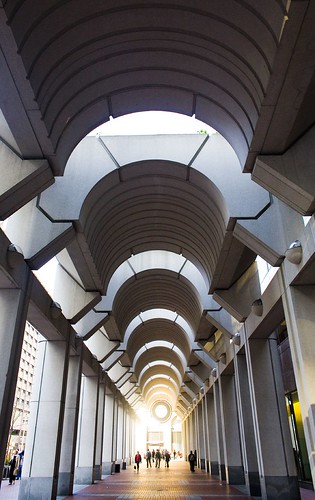
This was one of the shots I was able to get at the JP Morgan building after the security guard left me alone.
Now stuff like this happens to me all the time and I never blog it. It’s inconvenient, it’s unfortunate, but it’s not the end
of the world. I’m blogging it now mostly to show how the situation contrasted with my experience at 45 Fremont.
Personally, I don’t mind talking to security guards. A little banter back and forth even is a little fun. But rights are rights and they need to in the end let me do my thing and it’s nice if they are polite about it. The guy at the JP Morgan Building on Mission Street was polite about it. He was doing his job but in the end I was still able to shoot the building trouble free. And he could always say if ever questioned that he tried to stop me but that I wouldn’t comply.
I hope that these issues with photographers vs. security guards will get easier in the years ahead. I hope that as more and more people get digital cameras that there is more peace between photographers and the public and security. And I hope that more photographers feel comfortable shooting buildings and knowing that they can stand their ground. I know I would appreciate it if more of them did because I think when we take time to educate guards that it’s better for all of us.
The Curve of Her Back

Federal Reserve Bank of San Francisco