
Detroit Public Schools Book Depository
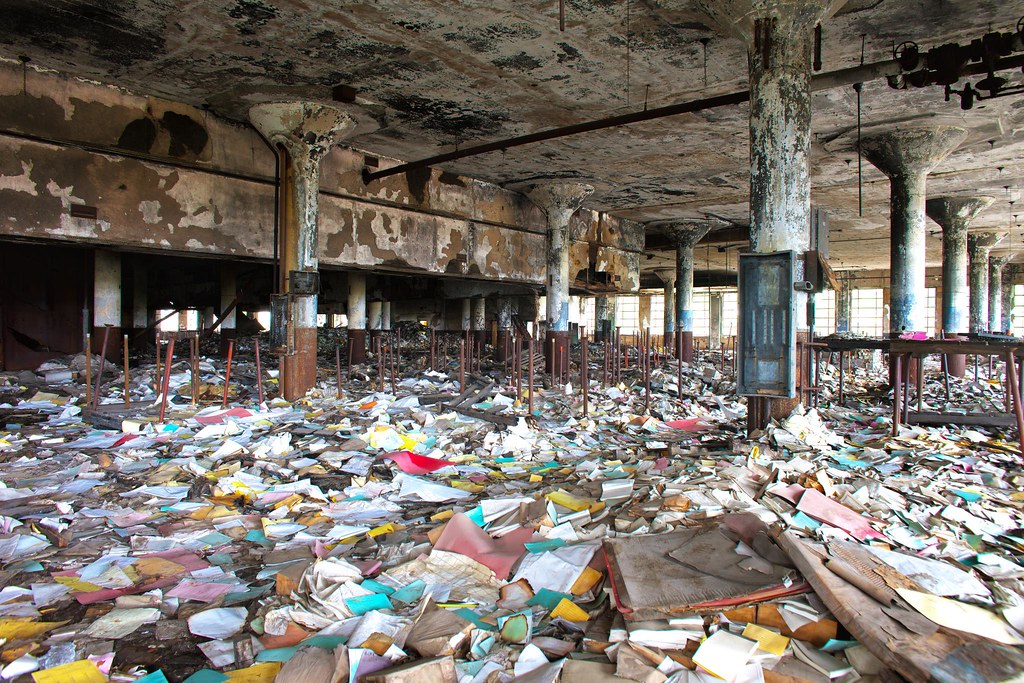
The Detroit Public Schools Book Depository has been abandoned since a fire struck the building in 1987. Designed by the well regarded Detroit architect Albert Kahn in the 1930s, the 4 story building was originally built as a post office before being converted to a warehouse holding school text books and other school supplies for Detroit school children.
As Detroit’s population has contracted, many schools have closed and are now shuttered and abandoned.
More recently, in January of 2009, The Detroit News reported on a case of a dead man who had frozen inside a block of ice in an elevator shaft in the building. As the story goes, the dead man was phoned in to a reporter rather than the police because the photographer/urbex explorer and his friends who were playing hockey on the ice in the basement didn’t want to call the police for fear of getting in trouble for trespassing.
At present the book depository and Michigan Central Station across the street are owned by Detroit billionaire Matty Mouron who also owns the Ambassador Bridge, the main bridge connecting Detroit to Canada.
On the day that I visited the basement was flooded. We only ran into one person living in the building, who asked us to keep away from the windows while we visited so as not to draw attention from the outside. On the fourth floor of the building nature has begun to reclaim this building and a small forest has taken root inside the building opening to a massive skylight in the roof.
This place definitely ranks up there in one of the most interesting abandoned buildings I’ve ever photographed.
Beware of the Pool, The Blue Bottomless Pool

Heartbreak Hotel Restaurant

So Baby, Kiss Me Like a Drug

Adobe Lightroom 3, I Feel the Need for Speed, Oh, And The Most Significant Advancement In Photo Noise Reduction I Have Ever Seen
For the past week or so I have been editing my photos exclusively with the official release of Adobe Lightroom 3. There’s alot to like about the new version of Lightroom, it’s faster and more stable than previous versions, it has some cool new lens calibration features, it has better watermarking features, more natural post crop vignetting, you can tether the program to your camera now and watch your photos in near real time as you shoot them in a studio, and lots more. But far and away, the single most compelling feature of the new release comes down to two simple words: noise. reduction.
Quite simply Lightroom 3 represents the single most significant advancement in photographic noise reduction I’ve ever seen. I’m *blown* away. Thousands of photos that were previously unworkable for me, now have suddenly become available to process. High iso low light shots with tons of noise can be salvaged, saved and turned into beautiful images. What’s more, pushed to it’s extremes, this new noise reduction technology gives photographs an almost painterly quality, allowing new potential for artistic representation of photographs.
In fact, combined with new in camera technology allowing isos to be bumped to as high as 6400 natively, this new noise reduction technology by Adobe opens up a whole new world of hand held night photography never before available. Not having to worry about the noise at 6400 iso (or higher) gives today’s photographer an enormous amount of freedom to pursue low light subjects that as recently as one year ago would have been simply unthinkable.
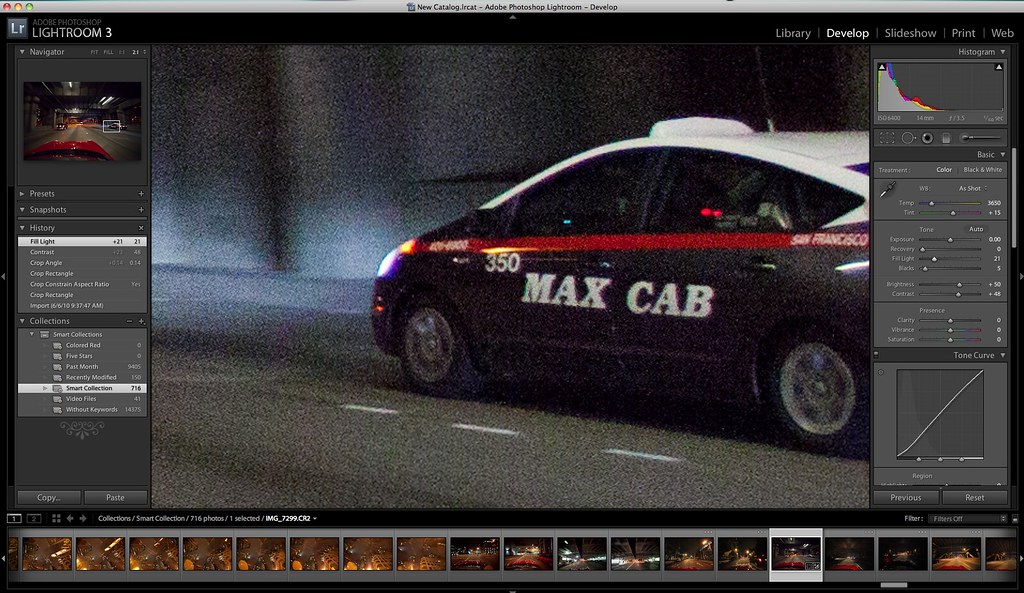
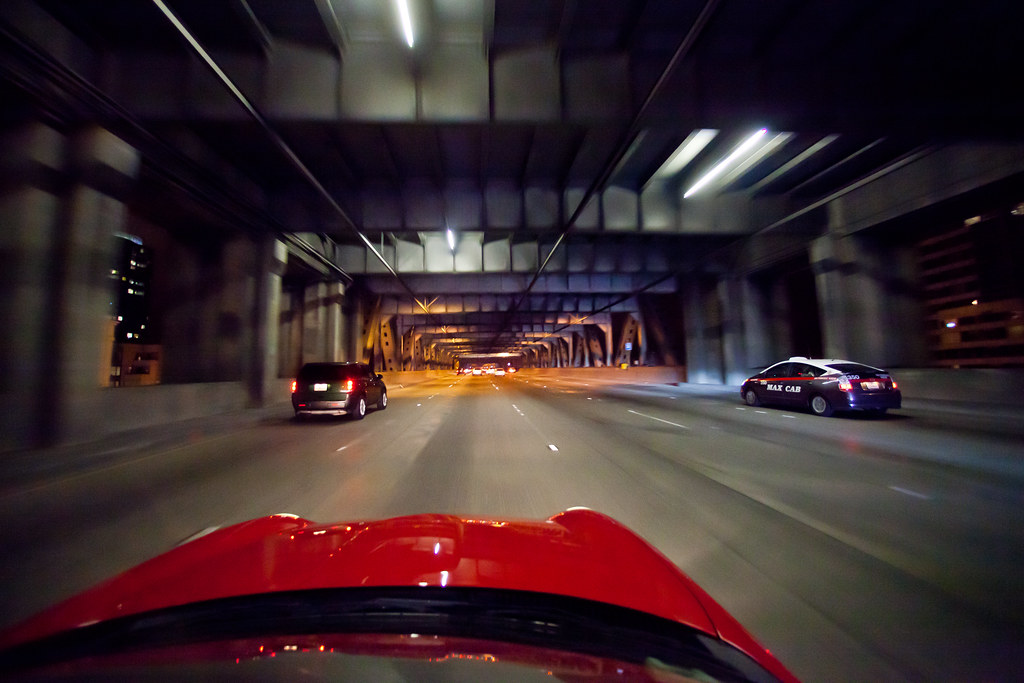
The photo above is a photograph of mine shot at 6400 iso taken on Saturday night while driving a red convertible sports car over the Bay Bridge, (don’t worry folks, I was the passenger, not the driver). The shot was done hand held as I was standing in the fast moving car at night. The photograph has the following settings (iso 6400, f/3.5, 1/60th of a second exposure). I’ve zoomed in on a very small detail portion of the photograph to display the noise at 6400. If you want to get a closer view at this image you can click through here and see it directly.

Now. Look at the exact same photo after I’ve used the luminance noise reduction slider to remove the unwanted noise. As you can see, the difference between the before and after is remarkable and dramatic. You can also click through here to see this screenshot in greater detail.
Unbelievably good! In addition to the impressive advancements in luminance noise reduction, Lightroom 3 also has made new advancements in color noise reduction as well. The noise reduction improvements in Lightroom 3 were so dramatic for me that it was hard for me to get as excited about some of the other improvements by comparison. But there are lots of other new features and improvements in the new version.
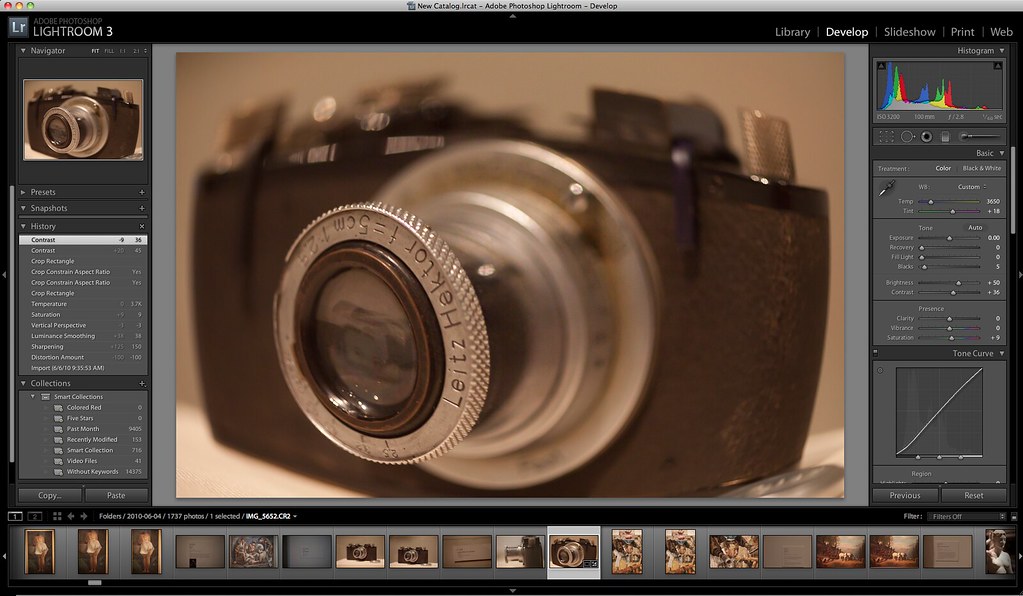
I’ve only played around a little bit with some of the new lens correction tools, but they offer some very impressive abilities to pretty significantly alter or improve basic lens distortion. Of course you can also use this new feature to do some interesting and extreme things with your photos as well (for instance turning a regular photo into an almost fisheye photo, like in the photo above). The new version of Lightroom also includes some cool new profile tools which allow you to use existing (or future created) profiles to match up your specific camera with your specific lens and have Lightroom automatically make the known lens correction based on that profile. For the purist who wants their photo exactly like it was shot using their exact set up this will be a nice feature.
The lens correction features also include a unique “perspective” lens correction that can turn a photo of a sign or building or whatever shot up at or down at to look more like it was shot directly at.
Other notable improvements include the ability to add natural looking grain to a photograph (this is especially useful in working with black and white images), the ability to create more natural feeling post crop vignetting, the ability to import video files now directly into Lightroom, faster importing, more customized photo layouts for printing and more flexible watermarking. Lightroom 3 also simplifies publishing your photos to Flickr allowing you simple drag and drop functionality using the Flickr API and allows you to synch some of the photos in your collection directly to a folder to then be synched with your iPhone or Google Android phone so that you easily have the photos that you want on your phone.
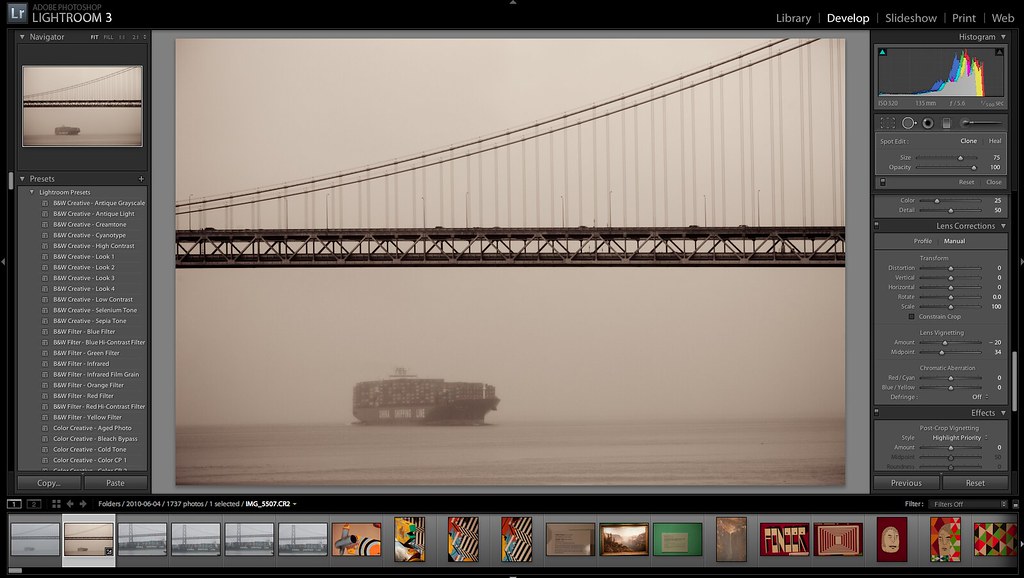
Adobe also ships a number of preconfigured presets with this version of Lightroom. Lightroom presets have been some of the most hotly traded items around the web amongst photographers. I wouldn’t say that the default presets are the best that I’ve ever seen, but they are a solid jumping off point for those who would like to work more with presets. Hopefully Adobe continues working with presets and adding more and more custom presets in the future. The photo above is an example of their “Color Creative – Aged Photo” preset.
All and all I’m extremely impressed with this version of Lightroom 3. It is by far the best tool that I know of today to process your photos. If you want to purchase a copy of the new Lightroom or upgrade a previous version of Lightroom you can do that here. The program costs $299 for a new copy or $99 for an upgrade from Lightroom 1.X or 2.X. There is also a fully functional trial version that you can try first before deciding to purchase.
Update: Stephen Shankland over at CNET has another good review here. CrunchGear has a review here. Kerry Garrison interviews Senior Lightroom Product Manager Tom Hogarty for the cameradojo Podcast about Lightroom 3 here. John Nack has a post here. A good link roundup from the Lightroom Blog here.
Yahoo, How Does Censorship Make Yahoo and the Web More Open and Social
If you want to see if Yahoo is censoring any of your photos go to the Flickr organizer here. Once you are there, click on “more options” at the bottom of the page. Where it says no privacy/safe search filter, change that to show restricted or moderate content. This will show you what photos of yours that Flickr is currently censoring.
Yahoo today announced that as part of their 2008 “Yahoo! Open Strategy (Y!OS) initiative” they are integrating with Facebook. Every time I hear about this so called Y!OS “open” strategy I’m puzzled.
So Yahoo will integrate with Facebook. But will they do it with the full version of Yahoo content? Or will they do it with the censored version of Yahoo content? At present Yahoo censors Flickr photos on the web institutionally. From the Flickr FAQ:
Note: If your Yahoo! ID is based in Singapore, Hong Kong, India or Korea you will only be able to view safe content based on your local Terms of Service (this means you won’t be able to turn SafeSearch off). If your Yahoo! ID is based in Germany you are not able to view restricted content due to your local Terms of Service.
So this means that photos of mine (like this 1874 painting from the Art Institute of Chicago) are effectively filtered out of view as indicated by Yahoo above.
Further, these photos are also completely stripped out of all RSS feeds even for all *USA* based accounts. So if I want to feed my Flickrstream into FriendFeed or Google Buzz these photos will be censored from that feed.
My Pal Merkley does some amazing work with fine art nudes. These are not pornography, these are elegantly structured intensely detailed productions. Right now there is only one way to see these photos of Merkley’s. You have to go to Flickr itself, change your default settings from “safe search” to allow moderate and restricted content and then I can see them on Flickr. But what if I don’t want to see them on Flickr? What if, you know, with a more “open and social Yahoo/web” I want to see these photos in my RSS reader or on Google Buzz or on FriendFeed or (apparently soon) on Facebook? Will I be able to see them? No, I will not. Because Flickr feels that RSS feeds must be sanitized of most of Merkley’s art, even for adults in the U.S. Even though I’ve designated on Flickr that I want to view this content. Even though I’ve certified that I’m over 18. Still, the only place that Yahoo will let me see these photos is in the official Flickr silo itself. (And not even then if I unfortunately happen to be from India).
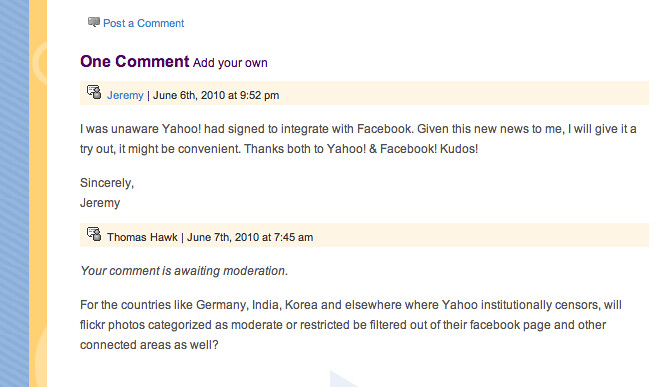
Unfortunately Yahoo seems to be unwilling to have an open and transparent conversation about this problem. I’ve been permanently banned from the Flickr Help Forum for asking pesky questions like this. I posted a very respectful question about this subject to the Yahoo Corporate Blog (see screen shot above) and it’s presently be censored (er. moderated). The Yahoo Corporate blog has no problem posting comments that kiss up to them. But dare criticize them and your comment is “moderated.” How is this more open and transparent?
If Yahoo truly wants to make Yahoo and the web a more open and social place, then they should stop censoring places like India and Germany and Korea. They should also stop filtering RSS feeds in the U.S. Believe it or not, some people actually don’t find paintings from 1874 at the Art Institute of Chicago offensive, even if the nanny’s at the Flickr Censorship Bureau do. By the way, I tried to appeal Flickr’s censorship decision on the painting from the Art Institute of Chicago and they refused to uncensor it.
Apparently full frontal male nudity on Michelangelo’s statue of David is ok, but a tasteful painting by Lefebvre showing the backside of a woman is not ok. How’s that for a double standard.
Victoria Kolakowski, The Unethical Choice for Alameda County Superior Court Judge, Tries to Argue That California Campaigns Can Hire Out of State Telemarketers to Do Illegal Robodialing
 (b) No person shall operate an automatic dialing-announcing device except in accordance with this article. The use of such a device by any person, either individually or acting as an officer, agent, or employee of a person or corporation operating automatic dialing-announcing devices, is subject to this article.
(a) Whenever telephone calls are placed through the use of an automatic dialing-announcing device, the device may be operated only after an unrecorded, natural voice announcement has been made to the person called by the person calling. The announcement shall do all of the following:
(1) State the nature of the call and the name, address, and telephone number of the business or organization being represented, if any.
(2) Inquire as to whether the person called consents to hear the prerecorded message of the person calling.
CALIFORNIA PUBLIC UTILITIES CODE SECTION 2871-2876
For the past few weeks I’ve been reporting on Alameda Superior Court Candidate Victoria Kolakowski’s illegal robodialing she is currently using as part of her unethical campaign for Alameda Superior Court Judge.
Kolakowski interrupted my son’s baseball game a few Sunday’s back when she illegally robodialed my cell phone with this recorded message by Oakland City Attorney John Russo.
Currently the California PUC (where Kolakowski is a sitting law judge sworn to uphold the law) regulates robodialing in the state of California. As you can see from the California code above, robodialing people in the State of California is explicitly illegal unless first introduced by an unrecored “natural voice announcement” asking if you will allow it. The fact that Kolakowski is a sitting law judge at the very agency that regulates illegal robodials (while using them herself) is troubling to me. Does Kolakowski think that she is above the law? And is this the sort of person we’d want as a Superior Court Judge?
Last week KCBS reported on Kolakowski’s illegal robodialing here.
Apparently the Kolakowski campaign has gotten back to KCBS claiming that “one interpretation of the law” is that her robodials are not “technically” illegal because she hired someone to make the calls from outside of the State of California. From KCBS’s update:
“Kolakowski says her calls, that feature the Oakland city attorney promoting her local candidacy, are being placed from outside California and thus outside CPUC jurisdiction. Under one interpretation of the law, that would make them legal.”
So let me see if I get this straight. Even though robocalls are *explicitly* illegal in the State of California, a law judge at the California PUC (the very agency that is charged with enforcing this law) thinks that it’s ok to hire some political hack to make illegal calls from outside of the state into the state?
So then under this logic all *any* company has to do to illegal robodial people in California is simply have the calls originate from out of state? So any California insurance company or bank or telemarketing scam selling auto warranties or carpet cleaning company or mattresses company or whatever, can just hire some company to start blasting millions of robodials into California homes and this is hunky dory? How fast do you think the California PUC would shut down an auto warranty scam from Arkansas targeting California seniors with illegal robodials?
The California Code to me is clear that not only can California businesses or corporations or campaigns not make illegal robodials, that agents on their behalf also cannot.
If *anyone* can simply pay to have their calls done from another state, this means that the California law does absolutely *nothing* to protect our privacy from these unwanted intrusions into our lives and homes. Under Kolakowski’s interpretation, our law has no teeth.
California businesses (including campaigns) should be subject to California law.
The fact that a current law judge at the PUC would try to twist the law this way is enormously offensive to me. But I suppose that’s just politics as usual. Politicians get to cheat and get away with it.
Even if one could argue this case on a technicality, the spirit of the California law is clear. It was enacted to protect Californians from these unwanted calls. I’m disappointed that Kolakowski would stoop to this low level and hope that you will join me in voting against her in the upcoming race for Alameda Superior Court judge. Our public servants should obey both the letter and the spirit of the law.
Update: On Slashdot here.
Music City

Water Falls