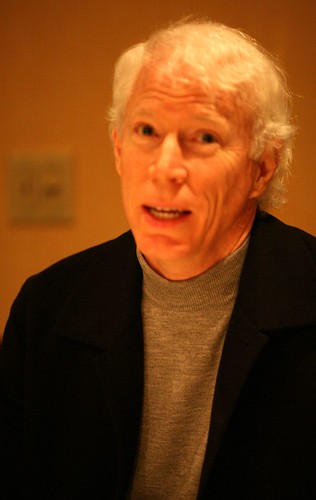
Microsoft co-president of Platforms, Products and Services Division, Jim Allchin
Last Night Jim Allchin, co-president of Microsoft’s Platforms, Products and Services Division met with a small group of bloggers and technologists here in San Francisco for dinner. The purpose of the dinner was to have an open and broad general discussion about Microsoft, their products and strategies, and general issues in software and technology today. Jim had met with a few of us back in April of last year for a similar meeting while down in San Francisco. Robert Scoble arranged the dinner along with Microsoft’s PR Firm Waggener Edstrom. In addition to Allchin, in attendance at last night’s dinner were: Neil Charney, Microsoft’s Senior Director of Windows Client Communications, Jim’s new Technical Assistant Jason Garms along with Linda O’Neill from Waggener Edstrom. Guests of the dinner in addition to myself were: John Tokash from Homestead Technologies, Beth Goza from Second Life, Tony Gentile from Healthline.com, Tara Hunt from Riya, Chris Messina from Flock, Phillip Torrone from MakeZine and Mena Trott from Six Apart.
First off, I have to say again, like the dinner last April, it is very cool that Microsoft is willing to open up senior management to bloggers. Whether because of Scoble or Waggener Edstrom or whatever, Microsoft gets blogging — really like no other big company out there. Not only does Microsoft have more employee bloggers than any other company, but I have found the employees at Microsoft and their PR firm Waggener Edstrom very accessible. Whether having lunch with Sean Alexander of Microsoft’s Windows Digital Media Division at CES, or trading emails with Charlie Owen and Matt Goyer on the Media Center Team (as well as “awesome guys” GM of IT Strategy Bill Koefoed and GM and head of business development in IW Sam Kamel) or chatting with Robert Scoble at one of his many geek dinners, there is a receptiveness and willingness to embrace bloggers outside their company that you just really don’t see from most big public technology companies. Jim had spent the earlier part of his day meeting with mainstream press and it was great that he was able to find the time in his schedule to meet with us over dinner as well.
Although I get that this dinner was set up for a reason (certainly Microsoft hopes to benefit from all of us writing about their products, etc.), this is smart strategy on their part. Similar to April’s meeting Jim was surprisingly candid in talking with us.
So what did we talk about? Most of my questions as you’d expect revolved around Media Center and Microsoft’s plans and strategies for digital media.
I asked Jim about the recent CableLabs certification of the Vista platform. Opening up Media Center to premium HDTV content through CableCARD technology and DirecTV is very exciting — and critical, in my opinion, to Media Center’s success in 2006-2007. HDTV was far and above the major overriding theme at CES this year. HDTVs are hot and it is important that Microsoft’s Media Center PCs be able to support this growing demand. Although as a platform Vista has been approved by CableLabs at this point, an important step that will still be necessary for the PC/CableCARD reality is CableLab’s approval for finshed individual OEM PCs as well. Although Vista has been approved, OEMs will in fact still need to get their individual machines certified by CableLabs as well. Central to this certification according to Jim is the idea of a “protective path.”
Getting something approved through CableLabs is no easy task and this will very much favor the larger OEMs who have the funds, resources and clout to get this done. Jim said to expect to see the CableLabs approved PCs out from the big guys first but reiterated his commitment to smaller OEMs in fighting for them to also get their machines CableLabs approved as well. Jim said that Microsoft would fight clawing and scratching for these smaller OEMs. It will be interesting to see between now and Fall what that will mean. What it means for you as a consumer though is definitely do *not* think that you can just buy any old Media Center PC today and then upgrade it for CableCARD support in the Fall when Vista ships. The entire PC will need to be certified and this is what I’m waiting for before I buy mine. I’ll probably buy a high powered Dell when they have one out and would expect as a large OEM that they would have one of the first CableLabs approved PCs to market.

Riya’s Tara Hunt
I also talked with Jim about Windows Media Player. Last April I complained to Jim at our meeting about how slow Media Center handled large digital media libraries. This of course has more to do with Windows Media Player than anything. As I’ve reported previously, Jim also confirmed that we should expect to see dramatic performance improvements for large digital libraries in Vista and Windows Media Player 11 (can I get a “hot donkey” please!).
I also asked Jim if Microsoft would be releasing a standalone version of Windows Media Player 11 for people with XP and he said that they would. Although it may not have all of the features as the player shipped with Vista and although Vista is the priority right now, Jim said that we could expect an XP version of the popular player down the road as well.
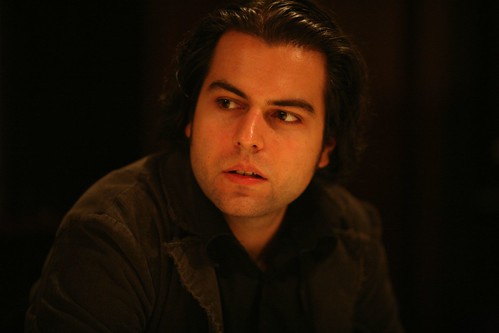
MakeZine’s Phillip Torrone
Another question that I had for Jim had to do with business strategy as it relates to the XBox 360. It has been rumored that Microsoft loses money on the hardware side of the equation with XBox because they sell the boxes for less than it costs them to make them. The idea has been that they then make up the difference by selling game titles. Jim said that although this may have been the case in the past that this will not be the case with XBox 360. Jim explained that when looking at XBox 360 you have to keep in mind that Microso
ft does not look at the cost to build the machine at today’s price only but over the life of the machine the costs to build it will drop considerably. In other words, to oversimplify, Microsoft makes the least money on their first XBox sold and the most money on their last XBox sold. Over the life of the product XBox 360 will in fact be profitable on a standalone hardware basis Allchin confirmed. Of course Microsoft still will make money on the games and Microsoft live type add on things that we will buy, but they will also make money on Xbox 360 units that are not used as gaming machines but solely by non-gamers as Media Center extender units.
I asked Jim about whether or not I will be able to copy new high def shows that I record on my Media Center PC over to my laptop or not. At present I copy a lot of the shows that Media Center records for me over to my laptop (which is my portable media device) for remote viewing. I have been concerned that with the DRM coming up in Vista that I would lose the ability to transfer some of my shows over to my laptop. Jim did in fact confirm that I might not be able to transfer shows to my laptop and said that with regards to the DRM associated with Vista that Microsoft would in fact honor whatever restrictions that the content holders decided to put on this content. This is disappointing to me of course as it means that I will probably lose my ability to transfer my shows for my on the road viewing. I would hope that in the future Microsoft could get a laptop to a point where it could be secure enough as an approved device to transfer copy restricted content over to it.
This brought up a whole larger conversation with the group about DRM, which all of us seemed to dislike, although some of us saw as a necessary evil. Tara Hunt expressed that she thought Microsoft should be doing more with respect to DRM in fighting Hollywood — that this should be their fight. Most all of us expressed frustration over problems and inabilities to transfer our media between devices, lost media due to proprietary formats, etc. While Jim sympathized (he does own an iPod by the way) he did point a lot of the blame of the interoperability issues at Apple Computer and Steve Jobs. While this is what you’d expect a Microsoft executive to say, in this case I happen to strongly agree with him. I have never purchased a single iTune and I will never purchase a single iTune as long as Apple keeps their format proprietary.
It frustrates me to no end that more people are not upset with Apple’s behavior. While I can certainly see where they have a right to make a profit, they have sold *so* many iPods at this point and made *so* much money, it does seem to me that opening up their format to other players would be the right thing to do. I still purchase all of my CDs directly and then rip the music at home so that I can have high bit rate, crystal clear, DRM free mp3 tracks. At present I don’t have a single song with toxic DRM polluting my digital library. I don’t own any iTunes and I think I was the only one of all of the guests last night who did not own an iPod.
We talked a bit about Vista’s features for your pictures. Vista will ship with a whole suite of super cool new features for all of us photobugs. In addition to some slick new slide shows that Microsoft demoed, you will be able to do much of the basic photo editing directly from the OS. This to me would seem well positioned to take a bite out of Adobe’s business as well as compete with free editing software similar to Google’s Picasa. One of the feature advantages that Microsoft will have with Vista though will be that even as you edit your photos (which you can see take place live right in the Windows Explorer folder) a preserved backup original copy of the image will be kept on your PC. This way if you edit a photo and then decide later that you want that photo back you can go back and get it. This will happen automatically and is a great feature for them to build into the OS.
You will of course also be able to tag photos quickly and easily in Vista. Jim said that this information will sit in the EXIF data field on the photo. This will be helpful and I hope that Flickr and others put a feature in place to automatically read the EXIF tag data that people enter in with Vista so that when you upload your photos to Flickr they are automaticly tagged. I asked Jim about whether Microsoft planned to do anything grand in the photo sharing space like Flickr and he said that they had some features in MSN Spaces and Messenger but that they did not have any plans right now to do anything in a larger context like Flickr. It would be nice of course to see a Media Center plug in for Flickr and I do suspect that we see something like that at some point.
Jim also demoed a lot of the new security features associated with Vista. While my interests are squarely in the eye candy digital media type stuff, Microsoft is probably focused most of all on this area of computing. As Neil Charney reminded us, “the happy internet playground is no longer so happy.”

Microsoft’s Neil Charney
Tara Hunt said that every time she visits her dad she has to uninstall IE and reinstall Firefox to keep his machine clean. I do the same thing for my parents. Maybe this coming Christmas though I’ll be uninstalling Firefox and reinstalling IE back on. In addition to all the fancy stuff coming in IE (tabbed browsing, etc.), Microsoft showed us a new feature service part of IE where Microsoft will begin analyzing internet sites. In Vista a user will be able to opt in to turn on an anti-phishing feature and they will be warned if they try to go to a phishing site (as determined by Microsoft) on a full page browser display. Users will have the ability to both report phishing sites as well as report false positives from this screen. Microsoft then has committed to hiring a staff of Microsoft employed analysts who will review the sites submitted to determine if they are phishing sites or not to keep these sites updated. This is an expensive, time consuming and burdensome process, but a super important one and it points to the fact that Microsoft is taking safety and security very, very seriously.
Microsoft also showed us some of their new parental controls in Vista. They are pretty advanced and include more advanced features than just what sites kids can go to — they also include what rating of games your kids can play, what hours they can be on the PC, etc. They also have a monitor your child type feature (remember trust, but verify) which will let you keep track of what your child is doing on the PC. Although this was one of the most comprehensive parental control packages I’ve seen (and with four young kids I like this), I do think that the monitor feature still needs improvement and should include a feature that takes a screen shot of your child’s computer ever 5 seconds or so to allow you to actually go back later and see what was on their screen. There is simple keystroke capture software that does this today and I would not think this would be a very difficult feature for Microsoft to build in to their monitoring package.
All in all we got a lot of good information from Jim again and I have to say thanks to Robert Scoble and Waggener Edstrom for putting this dinner together. It is great to stay on top of what Microsoft is doing and to be able to meet with Senior Management who can perhaps best clarify some of the most important issues around their business today.

Flock’s Chris Messina
After dinner I went out for drinks with Tara Hunt and Chris Messina and we talked a lot about Riya, Flock and what they are up to as well. Riya is still in alpha and they have currently taken it offline while they do some significant performance improvements. It should be back up soon and I’m looking forward to testing it. Flock seems to be one of the more interesting things going on in the browser space today. According to Chris they’ve had about 350,000 downloads of the browser software so far. I did try Flock a while back, but as I tend to get frustrated super quickly I abandoned it soon after receiving a few errors. The software is in beta of course, so these errors are understandable. I plan to reinstall Flock shortly and will to write up something more comprehensive on it.
Update: For more on the dinner be sure and check out John Tokash’s take, Chris Messina’s part one article, and Tara Hunt’s post on the evening.
Also, Microsoft’s Sean Alexander clarifies a bit on the CableCARD PC vs. the DirecTV HDTV option. It sounds like although you will not be able to upgrade your existing or home built Media Center PCs to CableCARD HDTV machines, you may in fact be able to do this with DirecTV.
From Sean: “Jim confirmed that in order to get HDTV over digital cable in a Windows Vista PC, you’ll have to buy a PC system that has been “certified” by CableLabs. Unfortunately there’s nothing Microsoft could do here – they must honor the wishes of CableLabs. I’ve been fortunate to be one of those who has been testing the technology and I have to say it’s fantastic. I’ve done A/B switching tests vs. my Comcast set-top DVR and see no difference in image quality, despite the fact that the tuner is a simple USB-based box (RNDIS) that you just plug your cable (and cable card) into and go. No news on whether free and clear QAM services will require a CableLabs certified system but I will check. I suspect local channels in HD may still be an often from after-market or home grown builders. In order to get your premium channels DVR’d you’ll need that CableCard-qualified system and CableCard installed by your local cable operator.
Also news at CES was the DirecTV Media Center announcement. In the future (timing wasn’t discussed), you’ll be able to have an installer come out and install a DirecTV tuner into your Media Center PC and get your local channels complete with DVR. As many know, DirecTV uses their own protection scheme with a “conditional access card” not unlike a cablecard. The big difference here is that they recognize the value in offering an after-market system installed by their own installers. In the past, it was DirecTV that was considered “evil” for their use of DRM and protecting their assets too stringently vs. Cable. Could the shoe be on the other foot? Only time will tell.”
Tags:
Microsoft, Vista, Flock, Riya, MakeZine, Six Apart, Waggener Edstrom, Homestead Technologies, Second Life, Healthline, Riya