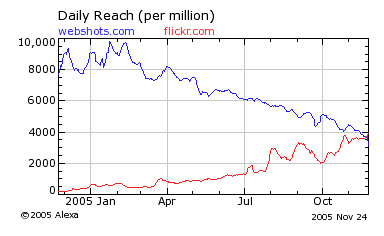
Flickr and WebShots – A classic web2.0 case Well it would appear that this week, at least according to Alexa, for the first time Flickr has overtaken Webshots in traffic. It’s been a trend that has been in the making for a while and I would suspect, having tried both services, that Flickr will continue to dominate over Webshots.
In comparing the two sites it would at first glance appear that Webshots has more users but less active users. At least as of last year Webshots was reported to have had 14 million users (I would suspect possibly less today). The most recent number I’ve seen from Flickr was 1.5 million users reported in the Business 2.0 article on November 14th. Although Flickr probably has less users, the users that they do have are most likely significantly more passionate users and evangelizers of the Flickr experience. Although I’ve not seen people refer to Webshots being as addictive as crack, it is a frequent comparison I’ve heard with regards to Flickr.
In my own experience having tried the two services I found that I preferred Flickr immensely for a number of reasons. Webshots seems to be much more advertising invasive than Flickr. Where Flickr serves up small little AdSense style ads to non-Pro users, Webshots has more of a robust advertising feel including larger flash based ads. If you do a search on WebShots it gives you back your results with an ad on the top, an ad on the side and an ad on the bottom all three. It also feels clunky compared to Flickr’s smooth and sleek design.
I also didn’t like the fact that without a paid account it does not appear that Webshots allows you to view high res images. Assuming the user authorizes it, Flickr allows anyone access to their high res images, both free and pro accounts.
Most of all though, I’ve found the community tie ins in the groups at Flickr to be a far more engaging experience. The Flickr sub communities that have sprung up are some of the stickiest out there and provide a rich and meaningful online social networking experience. I’ve made many personal friends through Flickr — although to be fair, I can’t say I really tried much on the social aspects of Webshots.
For what it’s worth Webshots does seem to generate quite a bit of traffic to your images. Webshots Founder Narendra Rocherolle and I traded blog posts a while back earlier this year about photo sharing and image search when he was still with the company. His involvement in the photo sharing business prompted me to try out Webshots at the time. I uploaded 160 photos to their site in total and since doing that in June, my photos at Webshots have been viewed 142,646 times. I was featured there as an “Editor’s Pick” on their main home page so that may have helped. Other than uploading those 160 photos though I have not been at all active on their site.
On Flickr on the other hand, I have been on longer and much, much more active. I upload photos every day, participate in numerous sub communities, have uploaded 2,876 photos, blog my Flickr photos at thomashawk.com, run a Flickr site and podcast and spend hours each day on the site. By contrast I have had my Flickrstream viewed 181,962 times.
I was surprised at how much traffic Webshots generated for my images with virtually no interaction at their site or significant promotion on my part.
Others have also begun to see Flickr as a superior site over Webshots for images. Earlier this month PR Blogger and Pro Steve Rubel was nice enough to mention my photostream in an article he wrote for his blog, Ten RSS hacks, that was subsequently featured on G4’s Attack of the Show. From Rubel: “I like to change my desktop wallpaper as often as I eat. So I used to subscribe to Webshots Premium. No mas. Thomas Hawk posts new original images every day in Flickr that are just incredible. I subscribe to his feed and download ones I like.”
Of course people in the photo sharing business probably saw this coming sooner and perhaps none sooner than Webshots founder Narendra Rocherolle himself. For those of you who don’t know Narendra, he was the founder of the original Webshots photo sharing service who made a pretty massive fortune selling Webshots not once but twice — once to ExciteAtHome in 1999 for $82.5 million, near the height of the dot com boom, and then after buying it back a few years later for $2.4 million, he sold Webshots again to CNET for $70 million last year. If Flickr was sold to Yahoo! for what has been rumored to be somewhere around $40 million, then it looks like Yahoo! may have gotten quite a bargain. And they still have Stewart, Caterina and the original Flickr development team working in their business in significant and meaningful ways.
After sticking around at CNET for a while Rocherolle left the company earlier this year and has now started a venture called 83 degrees. If you go to their website (you may need to go in IE instead of Firefox) you’ll see a tag cloud that looks a bit like something you might find at, well, yep, you guessed it, Flickr.
There is not a lot of information on 83 degrees, but they do seem to be working on something called 30 Boxes, Spliced (a weekly video blog) and something called weatherjam.
Erik Solheim asks the question, “Webshots started as a general photo sharing site in 1999 and are celebrating their 10th anniversary as a brand these days (they started out as a professional service around 1995). Flickr emerged around February 2004. So, how come that a new site with a name that is difficult to spell and impossible to pronounce can rival Webshots after less than two years?” Indeed Erik. I suspect that those of us who have become Flickr addicts understand and that many more will understand in the months ahead.
By the way, Erik came up with the idea in his original post for this story. I’ve subscribed to the RSS feed for Erik’s excellent blog for a while now. He blogs about Media Center as well and comes up with some pretty good stories regularly. I’d encourage you to subscribe to his site. If you like what you see I’d also encourage you to put a vote in for Erik’s blog for Gullbloggen. What is Gullbloggen you ask? Erik’s blog has been nominated by one of the biggest newspapers in Norway as the best Norwegian blog blogging about technology. Although I have to be fair and say I don’t read all that many Norwegian blogs regularly, along with the charming Elinesca’s blog (she’s also Norwegian) I’ve found Erik’s to be one of the best.
Update: Narendra Rocherolle took some time out to respond to my post above and has some corrections as well as some additional significant insights into the photo sharing business. His entire response can be read here, but I will post some of what I felt were important points and a couple of follow up thoughts:
“Webshots has no capital S. Never has, never will.”
Sorry about that Narendra. I should do a better job proofin
g things like that. I changed it in the post above. I can’t change it in the headline though because it will invalidate the link with people who have already linked the story. I’ll make sure not to make this mistake again.
“High resolution images are availble to free members on Webshots.”
That may be true but for the shot I tried it on, “Valley of the Gods,” by Jonathan Cummings I was prompted with this message: “Only Webshots Premium members can download our highest resolution photos (1600×1200 pixels). Highest-resolution quality allows you to see every vivid detail of your photo in crisp, clear colors! Upgrade to Webshots Premium and start downloading our highest resolution photos today!”
“It is a stretch to consider Webshots a Web1.0 company for numerous reasons. Webshots was the pioneer of a public photoblogging on a grand scale and has afforded millions of people the opportunity to quickly become involved in community and discussion around photos for many years. The business was sold a second time because of its very very long tail.”
Good point. Web 2.0 is difficult to define at best and perhaps not the best headline for the story.
Narendra also points out that per Alexa Photobucket actually ranks higher than Flickr and Webshots right now. He also adds: “When it comes to ratings, all these lists and charts are unfortunately only minor gauges. They all have flaws and are prone to wild swings.”
Good points Narendra.
Narendra also added this little bit as to the rumored price of $40 million that Yahoo! paid for Flickr. “There is a profound irony in the philosophy of “transparency” and the reality of deal structures. Everyone would love to know how much Weblogs, Inc. was sold to AOL for and the price is most certainly less than the wild speculation. The only semi-reliable data about the Flickr deal comes from Rafat scouring the Yahoo! 10Q to come up with
– In Q2, Yahoo bought three companies: the total estimated purchase price for all three was about $37 million and consisted of $32 million in cash consideration, $3 million related to stock options exchanged, and $2 million of incurred liabilities and direct transaction costs. That price includes the three publicly announced buyouts I could find: Flickr, DialPad, and Stadeon.”
Narendra has much more detail and more thoughts on the photo sharing business and I’d encourage you to read his post in it’s entirety.
Thanks for taking the time out to respond Narendra and I’d love to catch coffee sometime.