Think You Can Sell That Photo of Your Cat on Your Living Room Couch as Stock Photography? Think Again.

Shooter at Rest

I just got an email from Getty Images that I suspect is a mass email to all of their various contributors. In the email Getty is asking for help in identifying our photographs that might contain images of designer furniture. The email states that French courts have found in favor of the Le Corbusier rights-holders against Getty in a case where furniture was in the stock photograph.

Here is the email below with emails redacted:

“Attention all Flickr Collection on Getty Images Contributors!

You may have heard about a recent case (actually more than one case) where Getty Images and some of our photographers have had claims lodged against us in French court for images which include designer furniture, even as a minor part of the image.

This is a serious issue that involves potential liability for you as photographers.

The French courts have found in favor of the Le Corbusier rights-holders who initiated these claims. While we disagree with the decision and we are appealing it, we are very mindful that for now, it is a valid decision. It is critical that you understand that any claim like this one is extremely serious and requires action on your part in order to protect your interests, not just ours. We will continue to fight this decision, but in the meantime we must continue to actively pull content from our site that may be deemed infringing. We simply cannot identify all problematic images as quickly without your active participation. And quick action is vital.

Most importantly, if you believe that any of the images you have uploaded to us might possibly include any designer furniture, please email the Getty Images ID numbers to [email redacted] as soon as possible! The sooner we can identify and remove potentially infringing images the better we can reduce potential legal problems.

We are including links to information and FAQs that give more information on this issue and we strongly request that you read them and study the visual guides included.

You can also read the original Le Corbusier complaint here:

In English

Original in French (clearer photos)

Please note: because we are still engaged in litigation, we are very limited in what comments we can make or questions we can answer. If you do have questions please email [email redacted] especially for any specific images you believe may be a problem.

This is only for images you have on the gettyimages.com site. We cannot answer questions about images you have posted on Flickr or elsewhere.

Thank you for your help and attention to this very important matter.”

Photo Talk Plus, Episode 10, With Special Guest Jaime Ibarra

What an amazing episode! For Episode 10 of Photo Talk Plus we interview fine art photographer Jaime Ibarra. Jaime’s unique in camera work and especially his post production work take color to great photographic heights. By the way, check out Jaime’s awesome SmugMug site where you can buy prints here.

Joining Lotus Carroll and myself to interview Jaime are panelists Joe Azure, Sly Vegas, Charli Blake, Jackie Freeman, Keith Barrett, Petra Cross (from Google), and Cliff Baise.

?Trey Ratcliff also makes a surprise visit in the second half of the broadcast.

In this episode we talk about the New Nikon D800 and the new Canon 24-70 L Series lens, the winner of Chrysta Rae’s Scavenger hunt Kimberly Pemberton, an update on Carlos Miller’s arrest (including the video he was able to recover that the Miami PD allegedly deleted), and we talk about sensor cleaning techniques.

Thank you as always to our show sponsors SmugMug and Drobo! Be sure to check them out at http://smugmug.com and http://drobo.com.

Trey Ratcliff is Right About Pinterest

Trey Ratcliff is Right About Pinterest

“I look at my photography like this. When I make an image it belongs to me. It belongs to me while I take the photo. It belongs to me while it sits in my camera. It belongs to me while I process it on my Mac. It belongs to me while I let it sit in an archive folder waiting to be uploaded to the internet.

Then I upload it to the internet and it’s like I’m taking a bird and opening my window and letting it go. Off she goes. Her song to be enjoyed by the entire world — certainly no longer mine.” — Something I wrote about my photography a while back.

My good Pal Trey Ratcliff has a post out this morning about the hottest new site on the interwebs, Pinterest.

In his post Trey makes the case on why Pinterest is good for artists. This part resonated the most with me:

“A pure artist has two motivations: creation for the sake of creation and sharing for the sake of connecting with the world.

Sharing your artistic creation with one person is better than zero. Sharing your artistic creation with 20 people is better than 10. And so it goes.”

I’ve been on Pinterest for almost a year now (thanks Lotus Carroll!). The way I probably describe Pinterest to people most often is, “it’s what Flickr’s Galleries should have been.” Pinterest is one of the best curation tools on the web today. Using it is super easy. You just put a bookmarklet into your browser and click on it on any image on the web that you can share. That image is then presented on one of your boards as sort of an oversized thumbnail that links back to the original page that you are sharing from. TechCrunch says it’s 97% women. Well hello there ladies and Trey Ratcliff.

Being able to aggregate all your favorite images from around the web and share them in galleries is pretty cool. In Trey’s post he also makes what is I think a pretty accurate statement, “As this future becomes more and more plain to me, I see a rapture of sorts, where old-school photographers clinging to the old-fashioned ways of doing things will be “left behind.”

Alot of old-school photographers are upset about sites like Pinterest and another popular sharing site Tumblr. I see photographers complaining about their images showing up on these non-commercial sharing sites and getting all wound up in knots. Some photographers spend all their time scouring the web using tools like Tineye and Google’s Reverse Image Search to find every possible unauthorized use of their images and then run around the web grumbling about this.

As for me, I’ve always loved the curators, collectors and fans out there. I love it when people find one of my images and like it enough to want to share it on Pinterest or Tumblr or Google+ or wherever. I think that’s just awesome — as an artist it is my goal to have my work touch as many people as humanly possible. I want more and more and more and more people to see my work. I want people to think about it and react to it and appreciate it and share it.

Long ago I recognized that part of putting work on the web comes with authorized use and unauthorized use both — especially lots and lots of unauthorized NON-COMMERCIAL use. Sometimes people don’t even credit me per my Creative Commons license. Would I rather people credit me as the creator of the image? Sure. But you know what, if they don’t I’m not going to lose any sleep over it. Because I got over that sort of negative way of viewing the world a long time ago. It’s better for your soul to just let it go. If someone uses your image in a blatant commercial way against your license, there are resources for you to pursue. But especially when people are using your images in non-commercial ways, life is just too short to worry about the little things like that.

I, for one, welcome our new world that includes great new sites like Pinterest. I love that a vibrant new platform is emerging on the scene that celebrates beauty all around us. I’m honored that some in that community find beauty in my work and want to share that to others and so I’m a huge Pinterest fan.

Are you on Pinterest yet? You have to have an invite to get in. 😉

You can find me there here.

Photo Talk Plus, Episode 9, With Special Guest Carlos Miller

Lotus Carroll and I had a fantastic time interviewing Carlos Miller of the famed Photography is Not a Crime blog for Episode 9 of Photo Talk Plus. Interestingly enough Carlos had just been arrested 24 hours earlier for photographing an Occupy Miami protest. This was Carlos’ third arrest for his photography (he beat the rap on the first two). Carlos has championed photographers rights since starting his blog which covers all sorts of photographer rights issues online.

In our interview with Carlos, he talks about the arrest and the fact that the police deleted his video footage of his arrest after arresting him. Unfortunately for the Miami PD, Carlos was able to retrieve the video footage that was deleted. (see below). In the recovered footage it clearly shows that there were other individuals filming the police activity and what appears to be Carlos’ being singled out for an arrest simply for participating in his Constitutionally protected 1st Amendment right to videotape the police.

In addition to our interview with Carlos we talked about some of the top weekly photography related stories from Google+ include Joe Azure’s spectacular 15 minute photograph of the Golden Gate Bridge, Google+’s unofficial 100 million user number projected by Paul Allen, Billy Wilson’s most interactive people on Google+ Circle. and an update on Ivan Makarov’s Plus One Collection book.

This episode’s panelists included Denise Ho from Google Photos, Eric James Leflar, Amy Heiden, Keith Barrett, and Peter Tsai.

Thanks as always to our sponsors SmugMug and Drobo. Be sure to check them out at http://smugmug.com and http://drobo.com!


Video of Carlos Miller’s arrest while covering an Occupy Miami protest

Happy 8th Birthday to Flickr

Happy Birthday Flickr

“Yay! The gates are open and welcome Flickr testers. We are now in what is considered our preview release 1 of public beta. We’ll be fixing bugs, monitoring scaling issues on the back end, and adding a few features before going into preview release 2. Then we’ll go into preview release 3 and then when that’s good to go the beta period will be officially over.” February 10, 2004.

Today is Flickr’s 8th Birthday. Whatever you may or may not think of the service today, without a doubt Flickr pioneered social photography.

I joined Flickr during year one in August of 2004, shortly after it was launched to the public. What I found there was more than just a place to host my photos, I found a vibrant community full of great photographers who were willing and eager to engage with each other through the site. I found an audience that appreciated creativity and the ability for us to come together and share art in mostly a non-commercial setting.

The photo above was taken at Flickr’s 2nd Birthday party in San Francisco. Since Flickr’s launch, social photography has flourished on the web in so many different ways and in so many different places. I’ve been fortunate to have benefited tremendously from that over the years.

Happy Birthday to Flickr.

The Plus One Collection

The Plus One Collection

Wow! I just heard from my good Pal Ivan Makarov that the Plus One Collection sold almost 100 copies in the first day of taking orders. That’s pretty impressive for a $200 limited edition book. I think the book probably got a nice boost when Google Social Chief Vic Gundotra himself posted about it and bought a book yesterday.

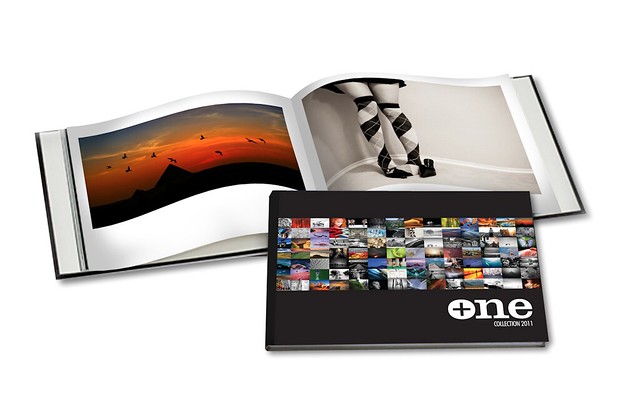
What is the Plus One Collection? Well 520 photographers got together on Google+ to create a collaborative book for charity (so far we’ve raised over $5,000 for Kiva). These are some of the very best photographers on the site and each submitted their best photo of 2011. A panel of 11 editors (I was one of these) using blind ratings then edited this down to 193 single page photographs (all 520 will be in the ebook but only 193 would work in the print book).

There are two editions of the book being offered for sale. A numbered limited edition 11×13 fine art book, printed on fine art paper, including tipped-in print, made to museum standards, available for only 9 more days — and another less expensive book that will follow fulfilled through Blurb after the limited edition sale. Each limited edition book also comes with a print from the book and a certificate of authenticity.

All of the work on this book was done by photographer volunteers on Google+. Ivan probably did the most work of all, but so many others in the community helped as well. Especially notable was the amazing design work on the book that photographer Andy Lee did. Ingo Meckmann designed the great website for the book.

100% of all net proceeds go to Kiva.

I’ve loved seeing this project come together as photographers from all over the world have contributed (literally only 65% of the photographers are from the US/Canada, the rest are from all over the world including Europe, Asia and as far away as Oceania!). The book shares a love for photography and fine art along with a way that we have been able to give back to the world that we all find beauty in and photograph every day. Thanks to everyone who bought a limited edition book yesterday, the price is steep but I think you’ll be proud to own a highly collectible edition of some of the best photography from 2011 while helping to support a very worthwhile cause.

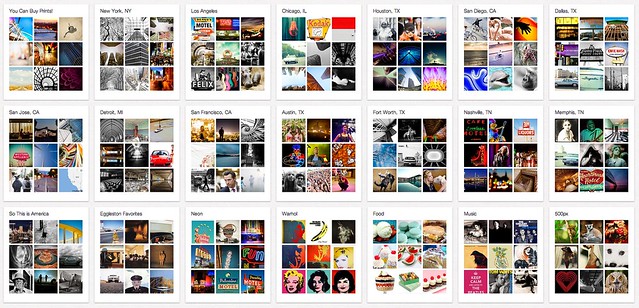
Flickr Getting Serious About Photo Meetups, Sets Up Corporate Page on Meetup.com

Flickr Sets Up Meetup Page

On today’s Flickr blog there is an announcement for two big upcoming Flickr photowalks. One is in New York on Saturday February 18th and already has 70 people signed up. The other is in Philadelphia on Sunday February 19th and already has 23 people signed up.

While these numbers are not as big as some of the photowalks that have been taking place over the past year through other sites, it is very interesting to see Flickr begin to get more active in the photowalking scene.

Even more impressive is what appears to be a brand new elegantly designed community page for meetups by Flickr at meetup.com. I played around a bit with the site and was very impressed — it’s much better designed than Yahoo’s own upcoming.com site and likely to attract much bigger participation in walks going forward — especially if promoted on the Flickr blog and through other official Flickr channels.

It’s also interesting to see that Flickr’s Head of Product Markus Spiering himself has organized and will be attending the two upcoming East Coast walks personally. Spiering is the guy who runs Flickr, so having him on the walks is a very visible way to show support for these kind of community events.

In the past I’ve been critical of Flickr for being out of touch with their users and the photo community. Earlier this year Spiering promised a “renewed focus” from Flickr this year and certainly beefing up community events, his own personal involvement, along with a page dedicated to these sorts of events by Flickr is a great way for Flickr to begin better re-engaging the photo community.

As a West Coast dude I won’t be able to attend these walks, but I love seeing this sort of community involvement from Flickr.

Today seems to be the first day that Flickr has blogged about the site — so far 142 flickr people have signed up from 33 different cities. It will be interesting to see what sort of momentum this site can attract.

Flickr Disables Snapjoy’s Flickraft API Key

Flickr Disables Snapjoy's Flickraft API Key

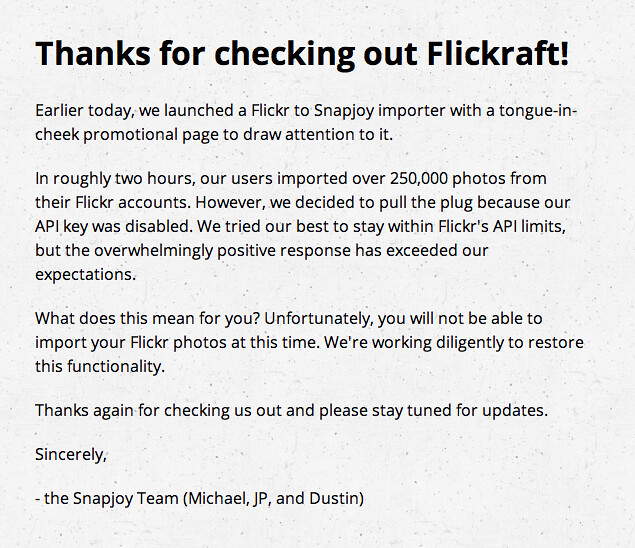
Yesterday photo hosting site Snapjoy launched what they called a “tongue-in-check” promotional page called Flickraft. The promo page provided a tool that would allow users to transfer their photos from Flickr to Snapjoy directly via the Flickr API. According to Snapjoy, in two hours their users imported over 250,000 photos and then they had their API key disabled by Flickr.

In Snapjoy’s case they likely ran afoul of some of Flick’s basic API Guidelines and Terms of Use. Here it spells out what you can and can’t do with an API key. A few of the things that you *can’t* do according to the API Guidelines and TOU:

“Don’t abuse or overtax the API. This means that if you build an app that excessively strains the Flickr servers, we will expire your key per the API. Don’t Use Flickr APIs for any application that replicates or attempts to replace the essential user experience of Flickr.com. Don’t Display more than 30 Flickr user photos per page in your application or use an unreasonable amount of bandwidth.”

Snapjoy also borrowed from the Flickr branding/logo (which is also prohibited) in crafting a clever marketing message making Flickr look like the Titanic.

I suspect that the API disable wasn’t done manually by anyone at Flickr, but that rather when they transferred over 250,000 photos that they probably tripped some sort of API limits put in place to more generically protect against abuse.

I reached out to Jaisen Mathai who used to work at Yahoo and now is working on a new initiative called Open Photo which would allow users better control over their photos and here is what he had to say:

“API rate limits are a double edged sword. From the provider (Flickr) side it’s required to curb abuse (which Yahoo! gets a crap load of, I was involved in these efforts during my employment). The other side is that things which aren’t exactly abuse often find a nice home under the “abuse” umbrella. This includes “export all of my photos to another site so I can stop using Flickr.”

Still, in the great big world of Yahoo bandwidth, should there really be a limit that prevents another site from transferring more than 250,000 or more photos from Flickr to their site. If this is the case, then many other more successful ventures in the future (like Google Photos or Mathai’s Open Photo) would effectively also end up locked out of the Flickr API.

Personally one of my concerns with regards to Flickr over the years has been functional lockin. While Flickr has given lip service over the years to data portability, in actuality, for the vast majority of flickr users, getting your photos out of the site is anything but easy.

One way to get your photos out of flickr is to use the service Backupify. But in order to use this option you can’t have more than 50GB of photos on Flickr (I have way more than this) and you have to pay them $19.99/month. You can also try some of the free apps that are out there like Bulkr or Downloadr. But these have serious flaws as well. Downloadr is PC only (I’m a Mac guy) and Bulkr limits you to 500 photos at a time (not ideal for someone with almost 68,000 photos on the site like me). I tried Bulkr a while back and found it buggy and not very easy to use. Relying on free apps designed by third party developers in their spare time hardly seems like an ideal solution.

Using the API to directly transfer photos from Flickr to other services is by far the fastest easiest way for users to get their data out of Flickr. A few weeks ago when I decided that I wanted to start selling prints of my photos I transferred about 5,000 of my 67,000 flickr photos from Flickr to SmugMug. I was *blown away* at the speed with which these photos moved over. Getting these photos transferred over to SmugMug was super easy. I used an app called SmuggLr that works as a Firefox extension. [Disclosure, SmugMug is a sponsor of our Photo Talk Plus show, tune in tonight at 8PM PST!]. It was fast, flawless and efficient. The way data portability ought to be.

SmugMug of course is a paid premium site geared more towards higher end photographers who want to sell their prints rather than simply a free photo hosting site like Snapjoy, so Flickr likely considers them less of a direct competitor and so they probably don’t consider them as “replicating or attempting to replace the essential user experience of Flickr.com.”

As a free hosting service, sites like Snapjoy might likely be considered much more direct competitors to Flickr… but then again, so might things like Google Photos or Open Photo.

The still unanswered question is, shouldn’t we as users have the right to move our data around smoothly and freely? After all, these are OUR photos right? Personally I’ve always been a big fan of Google with regards to data portability. Not only have they come out very publicly in supporting data portability with their Data Liberation Front, they actually show you how and have built a tool to make it super easy to export your photos out of Picasa.

As far as Snapjoy the site goes, I set up an account there a few years ago. It’s interesting. They seem to be going after more of timeline sort of thing (like Facebook’s timeline) than a direct community based photo sharing thing. There really is no community or photo sharing there at all. I can’t send you a link to one of my photos as far as I know — it’s more just a personal place for me to look at my photos in archive view. I didn’t really get much out of it so I haven’t used it at all since checking it out initially. I can already look at my photos in archive view on Flickr so I didn’t really see the point.

It is probably worth noting that Snapjoy also does not appear to have an API, Mathai thought that this was their biggest mistake in terms of trying to enable a Flickr to Snapjoy exporter.

“I applaud the SnapJoy team’s effort and am always on the side of startups. Their biggest mistake was not having an API themselves,” said Mathai.

“It might not have any impact on getting their API key whitelisted or reenabled, but it would give them a leg to stand on. The marketing of “get off a sinking ship” conflicts with the fact that they don’t have an API and “coming soon” doesn’t cut it. So in reality, your photos are safer on Flickr than SnapJoy because Flickr at least provides tools (though they may cripple it by rate limiting) to get your photos out. Moving from Flickr to SnapJoy is moving from one silo to another.”

More from TechCrunch, The Next Web.

Update: Michael Dwan, co-founder of Snapjoy, just emailed me back and said that as of this morning, they have not heard back from Flickr.

As far as an explanation from his side of things he offered the following:

“We imported just over 359K photos in 3 hours by making 9,459 api calls — an average of 3,153 per hour. Unfortunately, a glitch in our system caused a spike during one of the hours which pushed it over the 3,600 per hour limit. By the time we realized the issue, they had already killed our key. We momentarily exceeded the api limit and Flickr made the decision to kill the key rather than temporarily suspend it or throttle requests.

We’re happy many people got a chance to use the importer and many more are still asking for the functionality to return. We’re also thrilled by the response from people who made it into the beta. We’re working to bring the functionality back and have rewritten the offending code so this isn’t a recurring problem (for Flickr or any other site we integrate with).”

Facebook Rolls Out New Lightbox View

Facebook's New Lightbox View
Facebook’s New Lightbox View

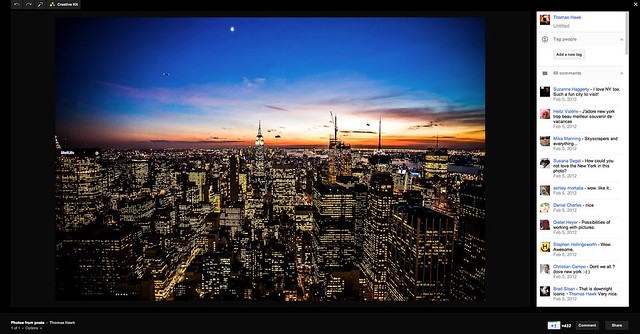
Google+ Lightbox View
Google+’s Lightbox View

Today for the first time I noticed that Facebook has rolled out a new lightbox view for photos. There were rumors of a new Facebook Lightbox view coming already out in the wild, but this was the first time that I saw it myself.

At first blush it looks like quite a bit of it was copied from inspired by Google Photos. Remember Vincent Mo, imitation is the sincerest form of flattery. 😉

The biggest change is that that comments on Facebook photos have been moved over to the right. Also it’s interesting to me that they seem to have dropped adverts on photos that have enough comments to require scrolling. This probably makes sense as it’s a way to reward high value (i.e. highly commented) photos on Facebook and below the fold adverts (where the adverts go under the comments) probably wouldn’t fetch as much as above the fold adverts anyways.

Also now, when you hover over the photo it gives you the opportunity to “like” or “tag” the photo. This is in addition to the options already to like and tag the photo that are to the right of the photo and always showing. Facebook really must want to drive “likes” and “tags” to their photos, which does actually make a lot of sense as increasing social activity on photos will drive engagement.

Simply clicking off the photo to the empty space around the photo or pressing the escape key will bring you back to the regular page you came from.

Personally I like the new lightbox view by Facebook. It’s better than the old Facebook lightbox. It’s still not as good as Google+’s which still has a larger photo — but along with the new much larger photo thumbnails in the timeline view, it’s a step in the right direction. It also tells me that Facebook has probably noticed the success that Google+ has had with photographers and is looking to try and find ways to make Facebook more attractive to the photography crowd. Facebook’s photos have come a long way since pre-Google+. Back then photo thumbnails were ensy weeny — the size of a postage stamp.

If I were Facebook I’d still make the lightbox view much larger though (like Google+). When it comes to a photo in lightbox view, bigger is definitely better.

Facebook also still needs to give us a way to crop photos in the Timeline view. Right now the imposed square crop doesn’t always best show your photo and the “resize” feature (press the star above your photo in timeline view) weirdly crops just the top half of the photo. Facebook already does have a cropping tool that you can use for your main cover photo in timeline view, so I’d think (and I hear) that better cropping ought to be coming for timeline photos at some point.

What do you think? Do you like the new Facebook lightbox for photos? And which do you think looks better, Facebook’s or Google+’s? Any other thoughts on today’s new Facebook lightbox design?

Update:

Comments on the new change from Facebook users.

Comments on the new change from Google+ users.

Update: Mike Schroepfer from Facebook comments in the comments below: “Thomas and everyone else – thanks for the feedback.

We experimented with blacking out the entire background. However, we found that may people were confused about how to navigate back from the viewer. The semi-opaque black background tries to strike a balance between having great contrast in the photo and giving people an easy way to click out/get back to FB as they need. Either way I think it is a huge improvement from having a white background.

If you have any other comments or suggestions I’d love to hear them.”