Yet another unfortunate example of a police officer trying to enforce their own made up in their head laws about photography being illegal.
Is Photography Prohibited on an Airplane?
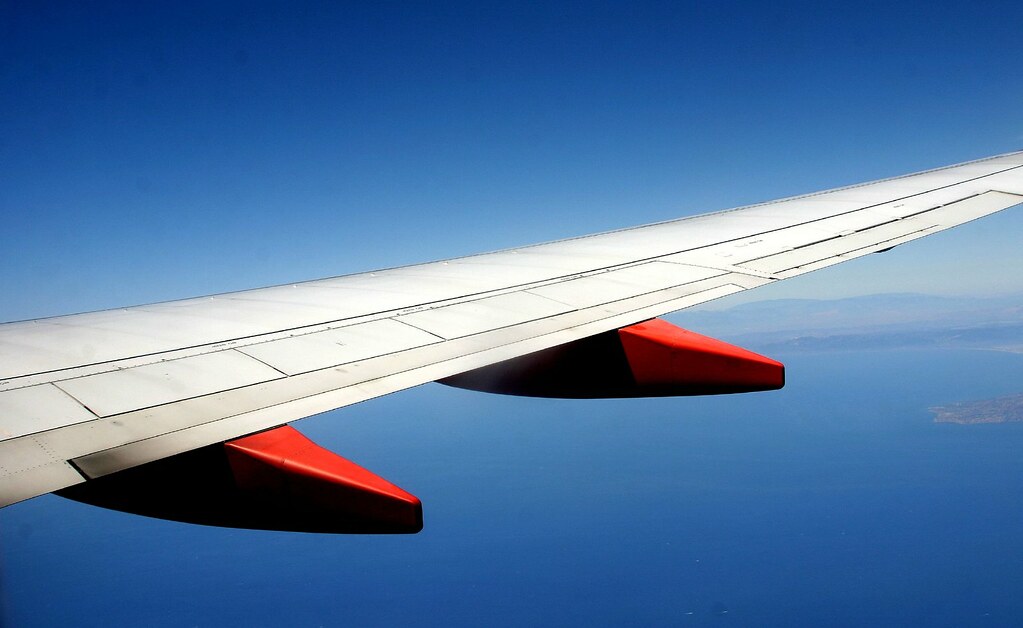
I received an interesting email yesterday from a business traveler who wanted to remain anonymous regarding a recent run in that he had with Air France Airlines and taking photographs aboard one of their flights. According to the traveler he was doing what a lot of us do and taking a photograph of the wing outside the airplane on take off. He said the way that the wings were closing reminded him of an eagle type gargoyle like on the Empire State Building and he was trying to capture that abstract photo when he was confronted by an Air France flight attendant.
According to the passenger, the flight attendant informed him that he was not allowed to take photographs once inside the plane. When he asked to see a written policy regarding the “no photos” rule the flight attendant left to retrieve one but never returned.
Now this case is not the first time that a flight attendant has admonished a passenger for in flight photography. There are numerous other cases online in internet forums and other places where passengers have been told by flight attendants that they cannot take photographs. In one of the most egregious cases a Jet Blue passenger was actually escorted off a plane in handcuffs after refusing to delete a video that she recorded of an on board altercation. Interestingly enough, Jet Blue actually had a photo contest of photos taken from their flights while appearing to prohibit photography in the case of the altercation.
Finding specific written policy information about individual airline policies is not very easy. Most airlines don’t list their in flight photo policies on their websites. I was able to reach a PR representative from Air France to ask about Air France’s specific policy given the complaint above, but have not been provided a definitive answer on this yet. The Air France PR rep asked for more information about the incident and offered to speak to the individual to clear up any misunderstandings but has yet to confirm that any such policy regarding photography on Air France flights either exists or does not exist. I’ll update this post if I hear back with a more definitive answer from Air France.
A representative from American Airlines pointed me to their policy online where it would appear that the type of photography our Air France passenger was engaged in of a wing while in flight would in fact be a prohibited act. You can find American Airlines’ policy here which reads: “Use of still and video cameras, film or digital, is permitted only for recording personal events. Photography or video recording of airline personnel, equipment, or procedures is strictly prohibited. “
I put in additional calls with both Southwest Airlines and Unite Airlines asking for information on their policies, but calls were not returned.
My own experience has been that I’ve never had a problem shooting from literally dozens of flights over the years. I even had a Southwest Airlines flight attendant offer to stand up from her seat on one flight so that I could get a good shot from her window of Mt. St. Helen. Still, it is troubling to hear of flight attendants admonishing passengers for on board photography. I also think that it’s unfortunate that more airlines aren’t more forthcoming with regards to what their actual photo policies are as some really great photography has been taken over the years from commercial air flights.
Update: Andy Beal points us to a pdf of Southwest Airlines’ permitted devices which lists both a digital camera and video camera as being permitted devices above 10,000 feet. I suppose this would be one more reason to fly Southwest over either Air France or American Airlines.
When “No Photography” Really Means “No Flash Photography”
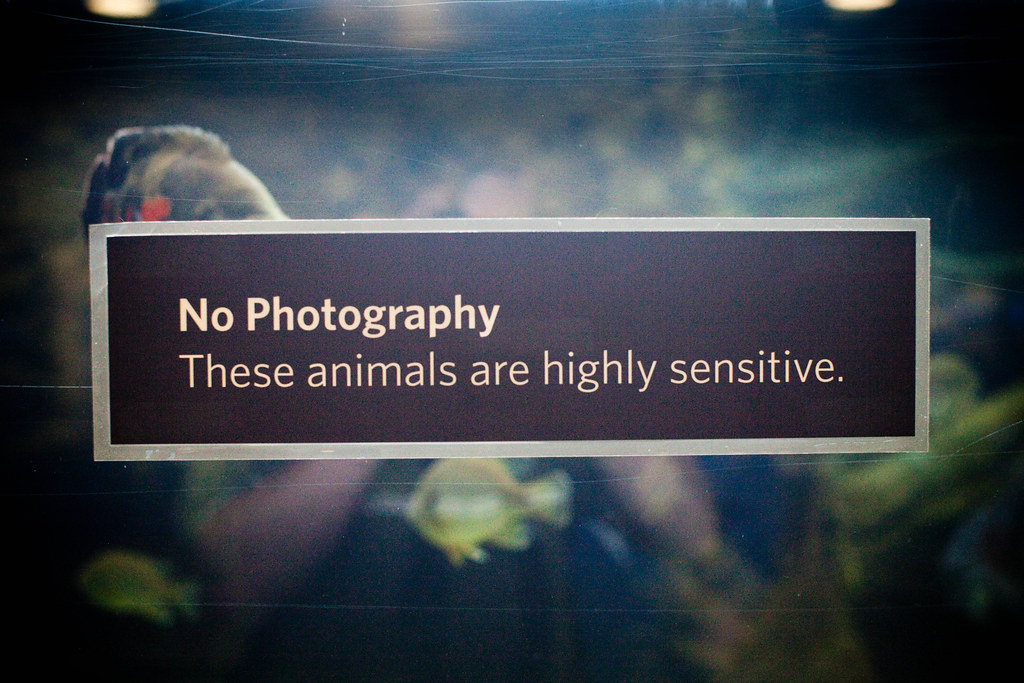
One of the things that annoys me to no end is when I see “no photography” policies that are put into place in order to restrict flash photography. Recently I encountered an example of this at the new California Academy of Sciences, a wonderful and remarkable museum where my family has purchased a family membership and which I’ve already shot pretty extensively so far.
I have to give the Academy high marks for allowing photography in the entire museum for the most part. It’s an incredible architecturally significant (and actually living) structure. The exhibits really are first rate and the fact that you can shoot there (and even wear a backpack) are really great. But I was disappointed recently when I visited and saw several “no photography” signs in the basement aquarium of the new museum.
People were ignoring these signs pretty much and shooting anyways, but that’s beside the point. I sat and watched one of the “no photography” exhibits for a while and saw several altercations between photographers and museum patrons. One patron chided another for taking a non-flash photograph, “can’t your read,” she curtly said to the photographer, “it says ‘no photography’ why do people like you always think they’re above the law.”
The photographer said that they thought that the museum meant no “flash photography,” (they were using an iPhone without a flash). The woman got agitated with the photographer and continued the altercation, “if they meant no ‘flash’ photography then it would say ‘no flash photography’,” she continued. “People like you are so rude,” she chided the photographer again.
After seeing a few altercations like this I decided to investigate this policy a bit so I went to talk to one of docents. I asked her why the signs were there and asked if it had to do with flash photography. She told me that actually it did not. She said that cameras have lasers in them and that when the shutter opens the laser in the camera can shoot out and harm the fish. Now, I know that there are not lasers in cameras, at least not in my new Canon 5D M2 that I was shooting with that day,” but I left it at that.
When I returned home from my trip I contacted the museum aquarium staff and inquired about the policy by email. The response that I got back was pretty much exactly as I expected. The museum staff confirmed what I assumed the reason why they had the “no photography” signs on certain exhibits was. They said it was to “be on the safe side, lest someone forget to turn off his/her flash.”
Now while I can see why the museum staff has this policy in place, I still don’t agree with it. My Canon 5D M2 doesn’t even have a flash on it. I couldn’t use flash on their exhibit even if I wanted to. And it sort of drives me crazy when people try to prohibit all photography based on arguments about flash.
So what’s the alternative? Well, they could easily replace the “no photography” sign with a sign that says “no photography without museum permission, or museum permit,” and point people to the staff offices for a permit. Here if there were photographers like me who really wanted to shoot those animals they could reconfirm and stress (if it’s indeed that important) that any photography must be done *without* a flash. I could then return with my simple paper permit in hand and when that batty woman who won’t mind her own business starts to chide me I could pull out my “permit” and show her that indeed I do have permission.
Of course as people mostly were just ignoring the sign anyways, while I was there at least, they could also just consider changing the sign to a more photographer friendly, “no flash photography,” with an explanation that flash really stresses the animals out to put extra emphasis on it.
They also might want to consider telling their docents that digital cameras don’t shoot laser beams. This is not Buck Rogers in the 21st Century — it’s a science museum, where it’s probably better that policies be based on real actual science, not science fiction.
Just Got Off the Phone with the FBI…
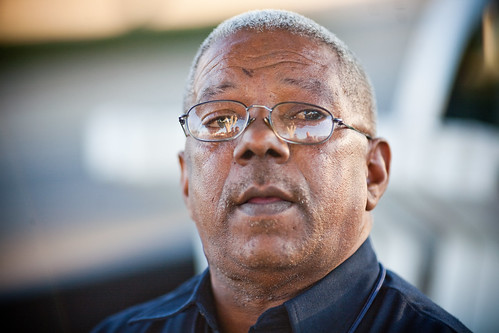 I just got off the phone with Terry Carter from the FBI’s Joint Terrorism Task Force. Carter contacted me regarding my run in with Securitas security guards (pictured to the left) down in Carson at the BP Refinery month before last.
The call was friendly enough. Carter assured me that his call was a courtesy call and that I was not in any sort of trouble. His main concern was asking to make sure that I harbored no ill will towards the United States Government.
I assured Carter that I harbored no ill will towards the U.S. Government that I was a proud American, etc.
We talked for about 15 minutes over the incident. Carter said that Securitas reported that they asked me and a friend not to take photographs and we ran away from them and jumped into a black SUV. I explained to Carter that this was not how the incident went down, that we spent a good 15 or 20 minutes talking to the security guard, but insisting on our rights to photograph the refinery. And only left after that.
I gave Carter my blog address which he asked for. I suspect I won’t be hearing from the FBI again over the incident.
Update: Apparently I got the agent’s name wrong. It’s Terry Carter, not Chris Carter as originally reported, my wife just called me from home and told me that he’d stopped by the house earlier today and left his business card asking me to call him.
A Humerous Take on Photographer Harassment From the Colbert Report
The Colbert Report had this great and very funny piece on a photographer who was harassed for taking photographs by Amtrak Police when he was trying to take photos for an Amtrak photography contest. Well worth watching.
Thanks, PDXSean!
New Law in the UK May Make it Illegal to Photograph the Police After February 16th
 I was disappointed to read a post that Paul Buchheit posted on FriendFeed today regarding recently passed legislation in the UK which might make it illegal to photograph the police there. The article, from Prison Planet, cites the Counter-Terrorism Act 2008 as containing the relevant legislation:
From Prison Planet:
“According to the British Journal of Photography, the Counter-Terrorism Act 2008, which is set to become law on February 16, “allows for the arrest and imprisonment of anyone who takes pictures of officers ‘likely to be useful to a person committing or preparing an act of terrorism’.” The punishment for this offense is imprisonment for up to ten years and a fine.
However, even before the passage of the legislation, police in Britain have already been harassing and arresting fully accredited press photographers merely for taking pictures of them at rallies and protests.”
In the UK, the section of the Counter-Terrorism Act 2008 that deals with this is in section 76, where it states that it will now be a crime to “elicit, publish or communicate” information about members of armed forces etc.
From the legislation:
“(1) A person commits an offence who—
(a) elicits or attempts to elicit information about an individual who is or has been—
(i) a member of Her Majesty’s forces,
(ii) a member of any of the intelligence services, or
(iii) a constable,”
While I’m still not exactly 100% sure what “ellicting and publishing information” about members of the police might entail, I could certainly see the issue being raised where an officer was identifiable, perhaps even with their name on their uniform. In any event, it certainly would seem to give the police more ammunition, so to speak, to be able to use when asking photographers not to photograph them.
This legislation would appear to be yet another chilling move by the UK in encouraging harassment of photographers. Last year you might remember that the London Metropolitan Police launched a very public advertising campaign asking people to turn in “odd” looking photographers.
Retaining our rights to photograph the police is important. Whether the Rodney King case or the more recent case of BART Police Officer Johannes Mehserle’s killing of Oscar Grant in Oakland, it is important that as citizens we be allowed to record the day to day activities of our police officers. Police officers wield an incredible amount of power over the general citizenry in our day to day lives. Being able to record their activities (as certainly they record ours) is an important right and power in ensuring that they handle their own power with the responsibility with which they should.
This law in the UK is unfortunate. It further muddies the water for what photographers can and can’t photograph with regards to the police and further paves the way for police officers to harass photographers. While the law seems to be targeted towards people who would photograph the police with the intention of using it for terrorism, I could easily see how it could be used by any police officer to try and stop photographers from photographing them. I would much rather have seen wording in this legislation that specifically said that regular citizens have every and all rights to photograph the police at any time.
I’ve taken a lot of photographs of the police here in the U.S. You can see my photoset “Cops” here.
Video Footage of US Bank Tower Security Guards Harassing and Threatening Photographers
The video above is an interesting one. You can read more of the backstory at Discarted, but basically a group of photographers headed out on a photowalk in Downtown L.A. only to run afoul of six security guards:
From Discarted:
“As we began photographing the US Bank Tower at 633 W. 5th Street, managed by Maguire Properties, we were approached almost immediately by a United Protective Services (UPS) security guard, and soon there were six (6!). We were told they would call the police and we would be arrested, that no pictures were allowed from their “private sidewalk,” that they actually owned the sidewalk, and that we were idiots and jerks who should quit asking questions.
The kicker is that, when Angelo of Hollywood politely explained photographers’ rights to one of the UPS guards, he responded that that was just “differing points of view.” Yeah … except that one viewpoint is about the law, and one is not.”
During the altercation, as is usually the case, the Holy Name of “9/11” was brought up yet again, as rationale for not allowing the photography. Seems like nothing ever changes. Be careful out there folks and remember, even under the new Obama administration, photography is still not a crime.
Thanks, David!
Update: an update on this incident from discarted here.
Santa Monica Pacific Park’s Weird and Confusing Photography Policy
Anthony Citrano decided to do some high ISO night shooting Friday Night on the Santa Monica Pier but quickly found himself in a confrontation with your friendly neighborhood photo police. According to Anthony, a confusing interchange took place between him and the photocops between what he could and couldn’t shoot on the Pier even though he was clearly shooting for personal non-commercial use.
 From Anthony:
“He then led me a short distance to a second security guy who explained that it’s OK to take pictures of “people, etc.” but I could not take pictures of park “things.” He described it as “private property” and “you see, everything you photograph in this park, it’s copyrighted.” I replied, “yes, copyrighted by the photographer.”
He seemed confused by that. So I asked, “is it a question of the subject matter of the photograph? that’s the basis of the policy?” Yes, he said, that’s the policy. “Otherwise, you need to sign a waiver and show ID.”
I asked how they determine what I’m photographing. Do you review the photos? “For instance, your colleague said it was `family’; how do you know who my family is?”
He did not have an answer for that, so decided instead to move on to a new line of reasoning. He said that “if it’s for commercial use” I would need to sign. Then – acting quite relieved – I said, “oh cool, then, because this isn’t for commercial use. So, can I go take some shots?” But still he said no, that I would need to sign the waiver if I wanted to take pictures of “park property.” I was confused, and told him so: You just said that the waiver was required if the images were for “commercial use”. They are most definitely not for commercial use. So why do I need to show ID and sign a document?”
You can read more about Anthony’s run in here.
Remember kids, stay in school, do what adults tell you. Cameras don’t kill people, people kill people.
Photography is not a crime.
Pacific Park photo by Anthony Citrano.
Update: The L.A. Weekly has picked up on this story and is running a post on it as well right now.
Photographers Criminalised as Police ‘Abuse’ Anti-Terror Laws
Photographers criminalised as police 'abuse' anti-terror laws – Home News, UK – The Independent:
"'The car skidded to a halt like something out of Starsky & Hutch and this officer jumped out very dramatically and said 'what are you doing?' I told him I was photographing the building and he said he was going to search me under the Anti-Terrorism Act,' he recalled.
For Powell, this brush with the law resulted in five hours in a cell after police seized the lock-blade knife he uses to sharpen his pencils. His release only came after the intervention of the local MP, Simon Hughes, but not before he was handcuffed and his genetic material stored permanently on the DNA database."
More madness from the Photo Police. Photography is not a crime.
Thanks, Gary!
MP Stopped by Police on Suspicion of Being a Terrorist – for taking photos of a cycle path | Mail Online
“A Tory MP was stopped and searched by police on suspicion of being a terrorist after taking photos of a cycle path, he revealed yesterday.
Andrew Pelling was taking the pictures to highlight a ‘long-neglected bicycle and pedestrian route’ in his Central Croydon constituency to Parliamentary colleagues.
But as the cycle path was near the town’s main train station, two police officers stopped him on suspicion of planning a terrorist attack.
Even when Mr Pelling, 48, showed the officers his House of Commons pass and explained what he was doing, they insisted on searching his bag.
After finding nothing of interest they sent the MP on his way. A police spokesman confirmed the December 30 incident, saying: ‘The officer conducted a stop-and-search – taking into account the current terror threat – as he (Mr Pelling) was taking pictures in the vicinity of a major transport hub.’ “
Thanks, David!