
Amazing Grace

Dinner for Two

Wow! Warriorwriter Actually Wrote a Scholarly Paper on Flickr’s DMU Group
Wow! Warriorwriter Actually Wrote a Scholarly Paper on Flickr’s DMU Group for his course at Georgetown.
Excerpt:
“One such group is DMU. I had been a member of the Flickr community for nearly two years, and had participated in more than 20 groups, before my first experience with DMU on December 8, 2009. My first interaction with the group came after one of its members left unsolicited criticism on one of my pictures of photography equipment4. The member, Lee Shelly of Philadelphia, Pa. (leesure)5, saw my photo in another group where we were both members and commented that the work in my photostream (Flickr’s version of an online portfolio) did not justify the money I had spent on the camera gear in my photo. Offended by the apparent slight, I promptly blocked leesure from commenting on any of my shots. However, in the hours following my encounter with this DMU member, I began to notice something strange happening; my shot was receiving a massive number of views.
Flickr provides analytic tools for “pro” users like me who pay an annual 25-dollar fee to monitor activity on their accounts. I used those tools to track the location where all the visitors to my photo page were coming from. It turned out that leesure had posted a small version of my photo in a DMU post, which generated a great deal of discussion among the group’s other members. In his post, leesure disclosed that his main motivation for commenting on my photo had been jealousy of the gear pictured therein. He also pointed out that I had banned him from commenting on my images saying, “LOL…so he blocked me I guess. That’s funny since I offered [him] some help on how to actually shoot shots like that the right way…then actually went and shot one for him…including the setup shot.”6
I had never seen his follow-up offer of help because comments from blocked users do not display on the pages of those who are blocking them. Wanting to defend myself from what I perceived as unwarranted criticism, I joined DMU with the express intent of setting the record straight in lessure’s post and promptly leaving the group thereafter. The entire conversation in that initial thread could easily serve as the framework for a whole paper in and of itself, but the short version of my first foray into the DMU community is that I launched off on a self-righteous tirade about being respectful to other people, and found very little support for my viewpoint among the group’s members.
However, as the discussion progressed, I began to realize that there was something very authentic about the repartee. The members’ antagonism toward me was not entirely unwarranted, and there were undertones of humor in some of the jabs that reminded me more of fraternal hazing than mean-spirited bullying. I was curious to learn more about these people who regularly subjected their photos and viewpoints to the intense public scrutiny, and I ended the conversation by agreeing to disagree with leesure and accepting his invitation to remain a member of the DMU out-group.
Today, I am an active member in the group and remain a weekly contributor to the DMU photo pool. I have participated in four different photo walk meet-ups with other members over the past year in Washington D.C., Philadelphia, Dayton, Ohio, and Boston. I communicate with members in my area on a frequent basis, and go out on local shoots with them on occasion. I even made a recent trip to Morgantown, Pa. to shoot a high school football game with one DMU member with whom I have become particularly good friends, leesure.”
You can read the whole paper here if you are inclined or interested in scholarly publications. Apparently he’s going to work on it some more and try to get it published.
You can join the DMU group on Flickr here (please read the rules before submitting any photos to the pool). This is the group where I hang out the most on Flickr.
Central Thought and Action

Falling Faster
Top 10 Ways to Improve Flickr

Recently my friend Bill Storage asked a question in DeletemeUncensored titled “What’s Wrong With Flickr.” The thread wasn’t meant to complain about Flickr but to talk about how Flickr could be improved if one were starting from scratch. I wrote a couple of long responses out to Bill in the thread, but thought that some of the ideas really belonged in a longer-form blog post.
Alot of people give me crap for criticizing Flickr. They ask me why I use Flickr if “hate” it so much. The fact of the matter is that I don’t hate Flickr at all. In fact I love Flickr (even if they don’t love me anymore). I spend more time on Flickr than any other site on the web. I think Flickr represents the best place on the web for a photographer to share photos today and I think as a whole that Flickr is one of the cultural gems of our lifetime. What’s more, a lot of the stuff on Flickr works really, really well and is really really great.
That said, I’ve always viewed criticism as a positive thing. As something that helps us improve and grow. Hopefully we learn from our critics and hopefully one can view suggestions as opportunities for improvement rather than simple mindless negativity. I blog alot about Flickr because I care about Flickr. I care about photography on the web. I care about the greater Flickr community and I want to see it get better and better. So don’t see this list as a bitch list about Flickr, rather see it as some honest ways that Flickr can improve.
1. Improve the process on how account and group deletions are handled. Flickr is increasingly becoming known as a place that deletes accounts willy nilly without warning. Flickr’s “Community Guidelines” are notoriously vague (you can be deleted without warning on Flickr for being “that guy” or if Flickr feels that you are “creepy.”)
Many of my friends have had their entire accounts deleted for pretty minor offenses that are not specifically prohibited in more specific language in the TOS. In some cases photos with historical significance have been permanently lost. A while back Flickr nuked a group that I administered killing thousands of permanent threads. Thousands of threads by a group with thousands of members. Threads about cameras, workflows, photographic techniques, etc. Institutional knowledge stricken from the web forever.
Flickr really only should nuke accounts or groups as a matter of absolute last resort. They should try to work with their members (especially their long-term and paying members) if they find content that they object to. They should give members opportunities to take self-corrective action before just pulling the plug on their account. If they object to a single thread or a single image, they should just delete that image rather than nuking a user’s entire account.
When Flickr nukes a group or an account it says to a user, “I don’t respect you or your data.” It creates an atmosphere of fear and uncertainty is bad for community.
At Flickr when they nuke your account it is also permanent and irrevocable. There is no undo button. Even if Flickr staff mistakenly deletes an account or if a hacker maliciously deletes your account, there is no getting that data back. It’s gone forever.
Flickr could probably very easily create a system where deleted accounts are simply turned completely private and inaccessible from the web without actually removing all of the data. They could then give a user an opportunity to fix whatever they have a problem with in order to get their account turned back on. This would be a far better way of managing community than Flickr does at present.
2. Create a more robust blocking tool. Today at Flickr when you block someone, all it means is that they can’t fave or comment on your photos. This is a very weak blocking system. If someone really wants to harass you blocking them does nothing. They can still comment on photos after you do so that their comments show up in your recent activity. They can still follow you around in groups and post things that you’re forced to look at etc. Especially with cheap throw away troll accounts this creates unnecessary conflict on the site.
A few years back, over at FriendFeed, they developed a far more robust blocking system. When you block someone on FriendFeed they become entirely invisible to you. Not only can they not comment in your threads, anyplace else they post on the site is made invisible to you. They are wiped off the planet as far as you are concerned.
Now this would accomplish a few things at flickr. First it would give users far more control over eliminating anything that they found personally offensive or negative on the site. You don’t like my paintings of nudes from a museum and don’t like seeing them when you search for the de Young Museum? Fine. Then block me and you never see any of my content again. You don’t like someone who uses language that you find offensive in a group post? Fine, block them as well.
Second though, this sort of tool would encourage more civil interaction between users. If a user creates a troll account and starts behaving badly. They are quickly blocked and become irrelevant. This encourages them not to troll creating a more positive experience for the rest of us.
Many of the personality clashes that occur on Flickr could be avoided if Flickr simply empowered the user to block more robustly.
3. SmartSets. Having to manually construct sets is an incredibly inefficient way to build and maintain your sets. That’s why I use Jeremy Brooks’ SuprSetr. It’s probably the best third-party app ever built for Flickr. Flickr should hire Jeremy in fact as he’s doing groundbreaking work here, but that’s another topic.
Flickr should consider building SuprSetr technology directly into their Organize section. Let users build sets by keywords. It makes it much easier for users to build and maintain their sets. If I build a Las Vegas set for instance. In the future every single photo of mine keyworded Las Vegas, automatically gets added to this set when I run SuprSetr. Very slick.
4. Better Group thread management. At present Flickr has a very strong and robust Groups section. Here users can create groups (and there are probably literally millions of groups at this point) and talk about whatever they want and post photos into a pool. Games have been created around groups. Businesses have set up groups. Local communities have created their own groups. There are niche groups about anything and everything — from graffiti in South Florida to a specific neon sign in San Jose. Some groups have more robust discussion threads than others, but all offer this feature.
One of the problems with group threads on Flickr though is that you are constantly losing track of conversations that you are having because you have to manually go to each and every group to check the threads. If I post something in a group, but then don’t remember to go back to that specific group and that specific thread, I have no way of knowing if someone has answered my question or commented after my thoughts or whatever.
Flickr should create a page that aggregates all of the group threads that you are participating in or have chosen to follow. This page would encompass all threads from all group in a nice aggregated section. This way if you posted a really important question in a group three months ago that someone has finally got around to answering, you will actually see it, the moment it is bumped to the top of your aggregator.
Flickr should also allow you to hide group threads. Both in your aggregator as well as in the more general group view. If I don’t care about the latest Pentax camera (because I’m a Canon 5D M2 owner) I should be able to mute that thread in the group and never see it again. This would also help decrease negative trolling and bumping of threads on the site as offensive threads could just be hidden by a user if they didn’t want to see it.
5. Kill explore and replace it with a recommendation system based on your contact’s/friends photos. Flickr blacklisted me from Explore a while back after I wrote a negative blog post about actions that someone on their community management team had taken. They capped my photos in it at 666 (cute huh?). But this isn’t why I don’t like Explore. There’s a whole thread called “So I Accidentally Clicked on Explore” in DMU devoted to crappy photos that end up in Explore. The problem with Explore is that it largely shows you photos that you are less interested in. Broad general popular photos of cliches. Sunsets and kittens as the saying goes.
If I choose to follow people on Flickr, I’m probably much more interested in their style of photography or them personally than I am images in Explore. Maybe I’m a graffiti writer and am most interested in graffiti photos. Maybe my thing is mannequins. Maybe I want to see photos of classic cars. Whatever. Instead of presenting the community what Flickr feels is the best of the whole community, show each member the best of their contacts each, day, week, month. I would be far more interested in the photos of people that I actually follow, like, know, etc. Maybe Aunt Edna’s photo of her dog will never hit Flickr’s explore. But it just might hit my own personalized explore and because I know Aunt Edna and she is my contact, it might be a much more rewarding experience for me to see than say another random dog shot from a user that I don’t even know.
Flickr does have a page that shows your contacts most recent uploads, but this page is very limited and only shows the most recent 1 or 5 photos. There is also no way to filter it so that you see the photos that are faved/commented on the most and are likely to be the more interesting photos.
Get rid of Explore and replace it with something that is focused much more on your contacts than people you don’t even know. A personalized Explore would be a far more interesting page.
6. Improve Group Search. I have no idea why Group Search sucks so badly on Flickr but it does. Frequently you will search for terms that you’ve posted in group thread conversations and Flickr will not return the thread where the word exists. I would think that Yahoo! should know a few things about search and am surprised that searching for threads in groups has been so spotty for so many years. I have no idea why this is so bad, but it shouldn’t be.
7. Improve Data Portability. Flickr gives lipservice to data portability, but is not serious about it. As long as 99% of Flickr users can’t or won’t figure out how to move their photos easily to another site they are just fine with things. Functional lock in. The data that we put on Flickr is our data. It belongs to us. We are paying Flickr to hold it for us, but it belongs to us.
Recently my friend Adam wrote up a post on a help forum post about the language Flickr uses for encouraging people to buy Pro accounts. They said that they felt that Flickr is holding your photos hostage (beyond the 200 photo free limit) if you don’t upgrade to Pro. Only Pro accounts have access to original images on Flickr.
Flickr should let any member get their photos out of Flickr at any time. Further they should offer competitors API keys to allow them to build service to service direct transfer applications to move your photos to another service if you want. If I don’t want to renew my Pro account on Flickr and want to move my photos to Picasa, this should be as easy as me pressing a single button and having all of my photos transfer over.
Today it is very difficult and clunky to get your photos off of flickr. A few third party apps are available, but there are lots of problems with them. They fail if you have too many photos. They are only Windows based, etc. etc. Flickr has functional lock in and holds photos in a silo while talking about how they allow you to get your photos out of Flickr. Flickr should follow the lead of Google here and publicly both state and help make our data more portable. This ought to be part of being a good web citizen today.
8. Uncensor Singapore, Hong Kong, India, Korea, Germany and Maktoob.com. At present Flickr censors content to these places. It’s still mind boggling to me that a photo of a painting that I took in the Art Institute of Chicago can’t be seen by people in India. Trying to censor the world’s web is messy business. Flickr/Yahoo should take a stand for freedom and uncensor these locations. Google last year took a bold step of choosing to walk about from China rather than censor results there. Yahoo should stand for freedom and stop censoring in these places.
9. Let people sell their photos for stock photography. Flickr missed the boat by giving away stock photography to Getty Images. Stock photography is probably the single easiest way for Yahoo to dramatically increase the profitability of Flickr. Getty Images represents a tiny fraction of the images available on Flickr. The Flickr/Getty deal was probably done as a defensive move by Getty more than anything to keep Yahoo out of the multi billion dollar market that is stock photography today. What resulted is that users get a paltry 20% payout for a very small number of their images that can be sold.
Flickr could be a far more formidable competitor to Getty. Flickr has the size and market share to dramatically disrupt this market. The stock photography marketplace is *far* more complicated than this. But oversimplifying things, Flickr should offer two collections for sale (if a user chooses to offer their photos for sale). Cleared photos and uncleared photos. Uncleared photos should pay more to the photographer than cleared photos. Cleared photos would be reviewed by a team of stock photography experts (Yahoo could even buy one of the smaller stock agencies that already has experience clearing images) and result in a lower payout to the photographer. By turning Flickr into the world’s largest stock photography agency Yahoo could receive significant revenue from Flickr and Flickr photographers personally could benefit much more from posting their work there.
10. Build a better mobile app. The Yahoo built mobile app for Flickr sucks ass (sorry). As I understand it, it wasn’t even developed by the Flickr team. Over at Quora former Flickr Engineer Kellan Elliott-McCrea answers the question, “Why did Flickr miss the mobile photo opportunity that Instagram and picplz are pursuing?” There is no compelling mobile Flickr experience today.
Recently, one of my favorite Flickr photographers, Michael Wilbur, deleted his entire Flickr account and is now one of the most popular photographers on Instagram. Flickr needs to develop a more compelling mobile experience. Part of this should be a very easy way to view group threads via mobile.
There you go. Food for thought. And keep on flickering.
And Has a Way

Frederick Van Johnson Interviews me for the This Week In Photography Podcast
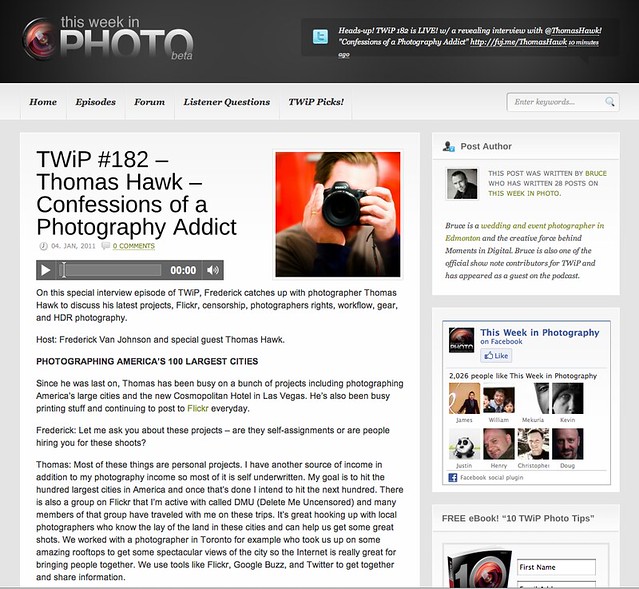
I had a nice opportunity to sit down and do an interview recently with my good Pal Frederick Van Johnson who does the excellent This Week in Photography podcast. We talked about alot of different subjects including Flickr, my 100 largest American cities project, censorship and photographer’s rights issues and lots of other stuff. It was great catching up with Frederick and talking about the passion that we both share for photography.
You can check out excerpts from the interview and hear the original podcast here.
20MB File Size Limits on Photo Sharing Sites are Stupid
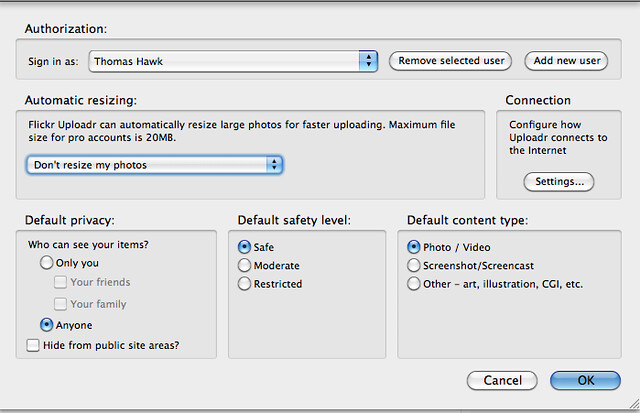
I noticed today for the first time that Flickr has been resizing all of my photos that I upload to the site over 20MB. I’ve known that Flickr has had a 20MB size limit for a while and in the back of my mind always sort of wondered why my photos over 20MB were still uploading to Flickr. I never really investigated it until today though.
Earlier this morning I uploaded this photo to Flickr. My original image is 5415×3610 pixels and is 23.5 MB. In Flickr’s bulk uploader (that I use to upload all of my photos to flickr) I’ve selected the option “don’t resize my photos.” Out of my 25 uploads this morning, flickr did in fact upload the actual originals of 24 of the 25 photos. The one that was over 20MB though was automatically resized to 2048 x 1365 pixels and now is a miserly 627KB.
While I can understand where Flickr might not want to notify me that my image was over the 20MB limit, reducing it down to a sub 1M file seems like overkill. I’ve always assumed that my photos on flickr could be perfect backup copies for me in the event that I lost my original photos (which are already backed up on multiple drobos and elsewhere in the cloud). It’s disappointing to know that even though I told the bulk uploader not to resize my photos that Flickr has been resizing some of my photos anyways. I suggest that if they are going to keep doing this that they put a disclaimer on the bulk uploader that photos over 20MB will be resized.
But lets talk about the stupid 20MB requirement in the first place. You can fit about 100,000 20MB files on a 2TB hard drive. You can buy a 2TB hard drive
retail now at Amazon.com for $80. (I guarantee you Yahoo pays less than retail).

99.99999% of Pro accounts on Flickr probably have less than 100,000 photos (and the same for 2TB). So Yahoo gets reoccurring fee revenue of $29 per year for each Pro account, but they have this stupid 20MB cap on photos that probably really costs them next to nothing.
Now maybe the 20MB cap limit made more sense a few years ago when storage was more expensive and DSLRs didn’t really produce 20MB+ sized images. But today’s Canon 5D Mark 2 (one of the most popular DSLRs with Flickr photographers) regularly produces a small number of files over 20MB. It seems stupid to me that to save pennies at best, Flickr would resize users’ photos (without really disclosing it to them). I think the time has come that Flickr at least consider raising this limit to 50MB. This would cover the bulk of the DSLR market out there today while likely costing Flickr very little.
Given that most people never view the original sized photos on Flickr I can’t imagine that bandwidth is a significant issue. And of course storage is only likely to get cheaper and cheaper in the months/years ahead.
So which innovative company is going to drop the stupid 20MB limit and let photographers actually upload their photos up to a more reasonable size without resizing (like say 50MB)?
By the way, Google’s Picasaweb Albums also has the stupid 20MB file size limit, which makes even less sense on Picasa because there you actually pay there by how much storage you use. What should they care if you upload 100 40MB files or 200 80MB files? You’re paying for the storage, why limit the file size?
Both of these of course are better than the Facebookery’s default of 2048 pixels.
Update: Rev Dan Catt, a former Flickr engineer offers a more detailed explanation about some of the reasons behind the 20MB file size limit in the comments below.